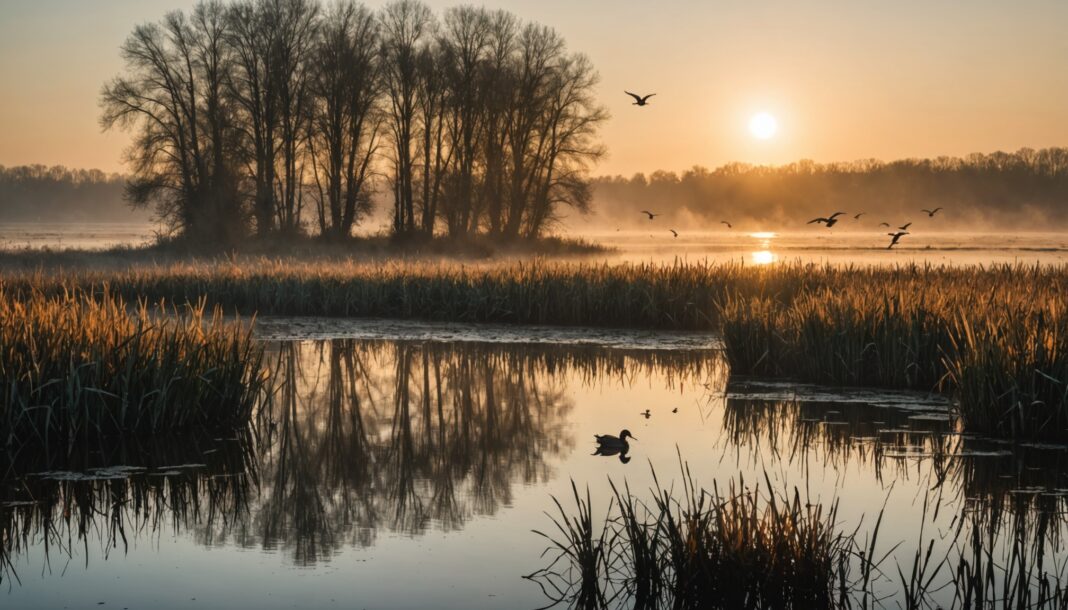
The hunting season opening this autumn looks set to be tense. Between a persistent drought that is weakening wetlands and the contested return of two protected bird species, hunters, public authorities and nature conservation organizations are opposing each other on several fronts even before the official start of the season.
An early opening marked by drought
As every year, waterfowl hunting opens before the general hunting season: early August on the public maritime domain, then mid-August for marshes, rivers, lakes and inland ponds. The general opening traditionally takes place between mid-September and the end of September, the exact date being set each year by prefectural decree in each department, which explains the calendar differences from one region to another.
This year, however, the climatic context changes the situation. The drought and heatwaves that have affected a large part of the territory have greatly lowered the level of wetlands, an essential habitat for migratory birds at this critical time. Several nature protection associations believe that maintaining waterfowl hunting in these conditions adds extra pressure on populations already weakened by the lack of water and the heat.
The contested return of the European turtle dove and the common pochard
Second point of friction: the Ministry of Ecological Transition submitted to public consultation, from July 30 to August 19, two draft decrees framing the hunting of the European turtle dove and the common pochard for the coming season.
- For the European turtle dove, whose hunting has been suspended in France since 2022, the government proposes a national quota of 12,000 birds, compared with 10,560 at the previous reopening, relying on an observed improvement in the population across the entire western migration flyway.
- For the common pochard, a quota of 5,000 individuals per year is being considered, with priority given to the taking of males, without, however, prohibiting the taking of females.
Hunters' federations welcome a decision that recognizes, they say, the management efforts carried out in recent years for these two species. Bird protection associations, on the other hand, consider the measure premature: common pochard populations wintering on the northwest European migration flyway fell by about 36% between 2006 and 2023, even if recent years show signs of stabilization.
What this means in practice for hunters
Beyond the controversy over these two species, preparation for the season remains subject to the same obligations as in previous years: validation of the hunting license, verification that firearms comply with regulations, and strict observance of the dates set locally by prefectural decree. The final quotas for the European turtle dove and the common pochard will only be known at the end of the public consultation, the results of which must be integrated into the final decrees before the effective opening of the hunts concerned.
For practitioners as well as for residents near wetlands, vigilance remains necessary in the coming weeks: a postponement or adjustment of the early opening dates cannot be ruled out if the hydrological situation does not improve before the general opening. The departmental hunting federations remain, as every year, the most reliable point of contact to know the exact dates applicable locally.
Frequently asked questions
When does waterfowl hunting open?
It traditionally opens in early August on the public maritime domain, then in mid-August for inland wetlands, before the general hunting opening in September, the exact date of which varies by department.
Is hunting of the European turtle dove allowed again?
A reopening project with a national quota of 12,000 birds was submitted to public consultation by the Ministry of Ecological Transition; hunting of this species had been suspended in France since 2022.
Why does drought cause concern before the opening of the hunting season?
The low level of wetlands reduces available habitat for migratory birds at a key stage of their cycle, which is why some associations are calling for a postponement of the early openings for waterfowl hunting.
Find other analyses on rural life and hunting, as well as our articles dedicated to ecology and the environment and to everyday practical life.
Sources
Profil de l'auteur
Derniers articles
 E-commerce, Shopping & Stores12 October 2026Lost, late or left on the doorstep: your parcel delivery rights
- Tech & Multimedia2 October 2026Mid-contract price rises: why pounds and pence can cost you more
- Electricity, Gas & Energy22 September 2026Standing charges: what you pay before using a single unit of energy
- Nutrition, Diet & Weight Loss31 August 2026Full-fat cheese : the surprising link to a reduced risk of dementia




This article was written with the help of artificial intelligence. Editorial policy
Table of Contents