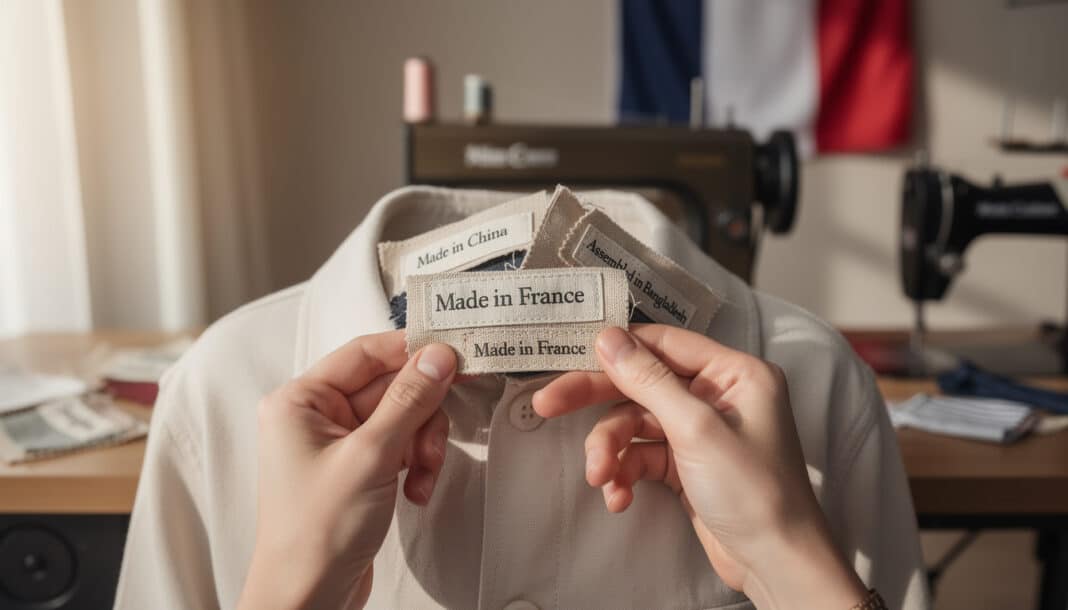
In short : “Made in France” has become an attractive marketing argument, but often a misleading one. 🚨 Behind this mention lie very different realities: only the last manufacturing step must take place in France to benefit from this label, which leaves the door open to abuses. Imported raw materials, simple local assembly, or even just adding a label can be enough to justify the designation. Between “Made in France”, “Designed in France” and “French Brand”, consumers navigate a maze of denominations that do not all mean the same thing. 📋 To make the right choices, you need to learn how to read labels, ask creators questions and recognize warning signs: an abnormally low price, the absence of details on the origin of materials, or reluctance to explain the manufacturing process.
🎯 The trap of “Made in France”: understanding the reality behind the label
When a French consumer discovers the mention “Made in France” on a product, they often imagine a wholly French manufacture, from start to finish. 🇫🇷 However, this perception rarely matches reality. According to customs rules, a product may legally bear this mention if its last substantial transformation takes place in France, without the rest of the process having been carried out locally.
This definition, which appears strict, actually opens a considerable gap. A textile manufactured in Asia and then assembled in France, a piece of furniture whose only French contribution is finishing, or even a garment to which only French buttons are added can all claim “Made in France” status. The hidden side of Made in France reveals how this legal ambiguity creates real misinformation among consumers who believe they are buying French.
The problem worsens when you consider that this “substantial transformation” is not clearly defined. 📝 What really constitutes an important step? An embroidery? A simple assembly? This regulatory vagueness has given rise to dubious commercial practices, where brands play with words and appearances to entice a clientele attached to economic patriotism.
📌 Misleading labels: decoding the claims that mean nothing
Before understanding what “Made in France” really means, you must first distinguish the different legal and marketing formulations you encounter on labels. Each tells a different story, and some are frankly misleading.
🔍 “Made in France” versus “Designed in France”
“Made in France” and “Fabriqué en France” are exactly synonymous: they mean that the last stage of production took place in France. 🏭 In contrast, “Designed in France” or “Conceived in France” absolutely does not guarantee local manufacturing. These mentions indicate only that the graphic conception or design comes from a French team, while the realization can be done anywhere in the world.
This is precisely the trap attentive consumers face. A garment can proudly display “Designed in France” in large letters, while in small print you discover “Made in China” or “Made in Bangladesh”. This disparity in formatting is no accident: it reflects a deliberate commercial strategy to mislead.
💼 “French Brand”: a label without guarantee
“French Brand” simply means that the company was created in France or is based there. 🏢 It is an indicator of the creator's origin, not of production. A French brand can perfectly well import 100% of its production from abroad. Supporting a French brand is laudable, but it does not guarantee manufacturing in France.
This terminological confusion benefits some entrepreneurs. Understanding the difference between the mentions Made in France and Origine France Garantie becomes essential to navigate the market with discernment.
⚠️ Warning signs: how to spot a fake “Made in France”
Faced with this jungle of mentions, how can you know if you are really buying French? 🤔 Several indicators can put you on the trail of a well-orchestrated misinformation.
💰 Price: an unmistakable indicator
A “Made in France” garment sold for €15? That's a major red flag. 🚩 Manufacturing in France implies labor costs significantly higher than in Southeast Asia or North Africa. Even with poor textile quality, it is almost impossible to produce locally at those prices without sacrificing margins or quality.
Generally, a textile product genuinely made in France costs at least two to three times more than an imported equivalent. 📊 If the price seems abnormally low compared to the supposed prestige of “Made in France”, ask yourself: what doesn't add up?
🤫 Lack of transparency: the primary source of doubt
Honest creators who manufacture in France talk about it abundantly. 💬 They detail their process, mention the names of their workshops (or at least their region), explain their choice of suppliers. Conversely, those who dodge questions about the origin of their materials or on the production steps are hiding something.
An aggressive or evasive reaction to a request for clarification is a classic symptom: the creator knows that their claim would not withstand careful scrutiny.
🏷️ Lack of clear indication on the label
If the label does not mention “Made in France” or “Fabriqué en France” in visible and readable characters, there is a simple reason: the product is probably not made in France. 📌 The law requires indicating the origin, and local manufacturers take pride in doing so. The absence of this mention, compensated by vague formulations (“Designed by French creators”, “French-inspired”), is a lie by omission.
🌍 Raw materials: the blind spot of French manufacturing
Even if the final assembly takes place in France, the origin of raw materials often remains unknown to consumers. 🧵 Yet this is a crucial element to assess the real environmental and ethical impact of a product.
A “Made in France” t-shirt can very well be made from cotton grown in India, spun in Turkey, and dyed in Bangladesh. Only the last step—the sewing or finishing—takes place in France. The “Made in France” label often conceals a far less flattering reality regarding the origin of materials.
The situation becomes even more complicated in certain sectors. 🔬 In cosmetics, French laboratories are numerous, but active ingredients are regularly imported. A product can therefore be “developed in France” while containing a majority of foreign components.
🇫🇷 The French textile sector: an underappreciated resource
Some French raw materials exist and represent interesting alternatives. French flax, for example, places France as the world's leading producer of this fiber. A textile 100% made from French flax—from cultivation to spinning, weaving and manufacturing—guarantees exemplary traceability and minimized environmental impact.
These transparent initiatives exist, but they remain the exception. The majority of “Made in France” products mix imported materials and local assembly, creating a misleading image of “Frenchness” that exists only halfway.
💡 Ethics and environment: is “Made in France” really more responsible?
The main argument that pushes consumers toward “Made in France” is moral and ecological: supporting local jobs, respecting strict social standards, minimizing environmental impact. 🌱 But does this remain true if only the final manufacturing step is French?
If the raw materials come from countries with lax social and environmental standards, the overall impact remains deeply mixed. A shirt made from Indian cotton grown with massive pesticides, dyed in Pakistan under polluting conditions, then assembled in Brittany cannot reasonably be presented as an ethical and ecological purchase, even if it bears the “Made in France” label.
The label creates the illusion of responsibility that exists only partially. 🎭 To correctly assess the impact of a purchase, you must examine each step: cultivation or production of the raw material, transformation, dyeing, transport, assembly. It's a demanding exercise that the “Made in France” mention makes superfluous in the eyes of many buyers.
🔗 Value chain and authenticity
Companies truly committed to responsible production communicate about every link in their supply chain. 📋 They explain why they choose a particular raw material, which partner supplies them, how standards are verified. This transparency strongly contrasts with the vague mentions of “Made in France”.
📊 Official labels: a real solution?
“Origine France Garantie” is often presented as a more reliable alternative to the simple “Made in France”. 🏆 This label, issued by third parties, imposes stricter criteria: at least 50% of the added value must be of French origin, and the decisive stages of manufacturing must take place there. That said, even this label does not require 100% French manufacturing or French origin of materials.
Other certifications exist, such as the criteria to avoid the trap of false industrial patriotism, but none are mandatory. A creator can perfectly produce 100% in France without requesting certification, simply because administrative procedures and costs are discouraging for small structures.
Labels offer some security, but remain insufficient for real clarity. 🤝 They do not replace transparency and the personal commitment of creators.
🎯 Genuine French creators: how to recognize them
Some distinctive signs characterize entrepreneurs truly committed to authentic French production.
✅ Radical transparency about production
Honest creators share precise details: the name of the region where manufacturing takes place, the types of machines used, the steps that are offshored and why. 🗣️ They present photos or videos of their workshops, allowing consumers to verify concretely.
Some even invite customers to visit their workshop or follow production in real time on social networks. This approach goes far beyond what the law requires and reveals total confidence in the quality and ethics of their process.
💭 Communication about limits and compromises
Real French creators also admit the difficulties. 🤷 Some items cannot be produced entirely in France due to a lack of suppliers. In that case, they explain why, where the imported parts come from, and what justifies the rest of their local production.
This honesty strongly contrasts with smooth, nuance-free marketing rhetoric. It signals an authentic relationship with the consumer, based on trust rather than manipulation.
🔐 Justified and stable prices
Serious French entrepreneurs offer stable prices, without aggressive promotions all year round. 💲 Massive and repeated discounts generally hide excessive initial margins or questionable manufacturing quality. A fair price, even high, often corresponds to real value.
Some creators explicitly explain their pricing grid: cost of materials, hours of work, depreciation of equipment, minimal margin. Discover the real differences between the mentions and pricing strategies that reflect real commitment.
⚡ Concrete cases: when disappointment is to be expected
Scams involving “Made in France” are not theoretical: they affect unsuspecting consumers on a daily basis. 😞
A highly followed creator on social networks was selling angora sweaters for €150 to €200, with messaging highlighting French manufacturing. When a customer received her order, the label revealed an entirely foreign production. When challenged, the creator reacted aggressively, confirming the initial lie. This kind of story repeats regularly in the fashion and accessories sector.
Another example: “hand-painted in France” water bottles sold at a premium price. 🎨 Yet the bottle itself is imported from Asia—there is no French manufacturer of blank bottles. Only the decoration added locally justifies the label. The consumer mainly buys an imported product, slightly personalized, but presented as “handmade French”.
These cases show that vigilance remains indispensable, even when facing seemingly established and professional brands.
🔎 Verify authenticity: the right questions to ask
Before buying a “Made in France” product, a few essential questions will help verify the truthfulness of the creator's claims.
🔹 Where exactly are the materials produced? Demand a precise answer: country, region, type of supplier. Vague answers (“In Europe”) should put you on alert.
🔹 Which steps take place in France? Entire manufacture? Only assembly? Painting? The creator's choice must be clearly stated.
🔹 Who actually manufactures? Although the name of workshops is not mandatory, a transparent creator will at least give you the region. A refusal to indicate even that is suspicious.
🔹 Why this price? Ask for a breakdown: cost of materials, hours of work, packaging, miscellaneous fees. A thoughtful and detailed answer is reassuring.
🔹 What does the label say exactly? Check yourself that the product bears “Made in France” or “Fabriqué en France”, not vaguer formulas. Analyze how to distinguish reality from fraud on labels.
Honest creators never hesitate to answer these questions. Those who dodge, delay or become aggressive reveal their ulterior motives.
🌟 Beyond “Made in France”: a more conscious consumption
“Made in France” should never be the only decision criterion. 🎯 It's one indicator among others, and a misleading one when not accompanied by full transparency and traceability.
True responsible consumption combines several dimensions: origin of materials, working conditions, environmental impact, product durability, authenticity of the creator's commitment. Each of these criteria deserves careful examination.
Whether you are looking for textiles, accessories, cosmetics or furniture, ask yourself the real question: what am I really buying? A fully French product, or the marketing image of a French product? 🤔
The answer will determine whether your purchase truly supports the local economy and ethics, or simply enriches entrepreneurs ready to exploit economic patriotism for their margins.
Profil de l'auteur
Derniers articles
 Smartphones & Mobile Phones14 October 2026The loyalty penalty on your mobile bill: why staying put costs you more
- Family, Babies & Children5 October 2026Airline family seating fees: what the planned ban will change for parents
- Everyday Life & Society23 September 2026Consumer confidence index: what the monthly mood check on British households really measures
- Agency, Webmarketing & SEO31 August 2026SEO : a Google bug skews visibility statistics in AI results




Table of Contents