



Summary 📋 — The Plan Épargne Retraite (PER) has become in a few years the must-have retirement savings tool in France. Created by the Pacte law in 2019, it is gradually replacing older schemes (PERP, Madelin, article 83) by offering unprecedented flexibility: capital withdrawal or annuity, early unlocking in seven specific situations, free transfers between contracts. But above all, the PER allows you to massively reduce your taxes thanks to deductions that can reach 45% of the amount contributed. Understanding its exact operation — the three watertight compartments, the deduction ceilings according to your status, the choice between deduction and non-deduction — is giving yourself the means to turn simple savings into a real tax lever.
Key points to remember 🎯
💰 Immediate savings — Up to €0.45 of tax saved per euro contributed, depending on your marginal tax rate (TMI). A taxpayer at 41% recovers more than €17,000 in tax each year on a €40,000 contribution.
📈 Three distinct compartments — C1 (voluntary contributions), C2 (employee savings), C3 (mandatory). Each has its own exit, tax rules and locking conditions. Ignoring this distinction costs thousands of euros.
🔄 Flexible exit since 2019 — Unlike the old PERP, the PER allows you to recover 100% of your capital at retirement, not only an annuity. You can also split withdrawals over several years to pay less tax.
🏠 Seven cases of early unlocking — Disability, death of a spouse, purchase of the primary residence, end of unemployment benefits, over-indebtedness, cessation of non-salaried activity, or a minor’s situation for PERs opened before 2024.
📊 Ceilings differentiated by status — Employee: €38,448 in 2026. Self-employed: up to €88,911 thanks to the double ceiling. Micro-entrepreneur: often limited to the guaranteed minimum of €4,806.
The PER, the retirement product that changes your relationship to saving 💡
For a few years now, the Plan Épargne Retraite allows you to build secure savings while benefiting from major tax advantages. But beyond the numbers, a new philosophy of retirement saving is emerging. Gone are the days of being forced into minimal contributions, locked up until 70, and obliged to take an annuity. The PER gives everyone back the power to steer their future.
Imagine this: you contribute €50,000 to your PER. If you are taxed at 41%, you immediately recover €20,500 in tax savings. That money doesn't disappear — it reinvests in your savings, which continue to grow for decades. It's the tax leverage effect that no other investment offers with this intensity.
Of course, there is a counterpart: this advantage is reclaimed on exit from the PER at the time of your retirement. But if your tax rate falls in the meantime (which is often the case), you have turned tax paid today into capital built tomorrow.
The PER's three compartments: an architecture often misunderstood 🏗️
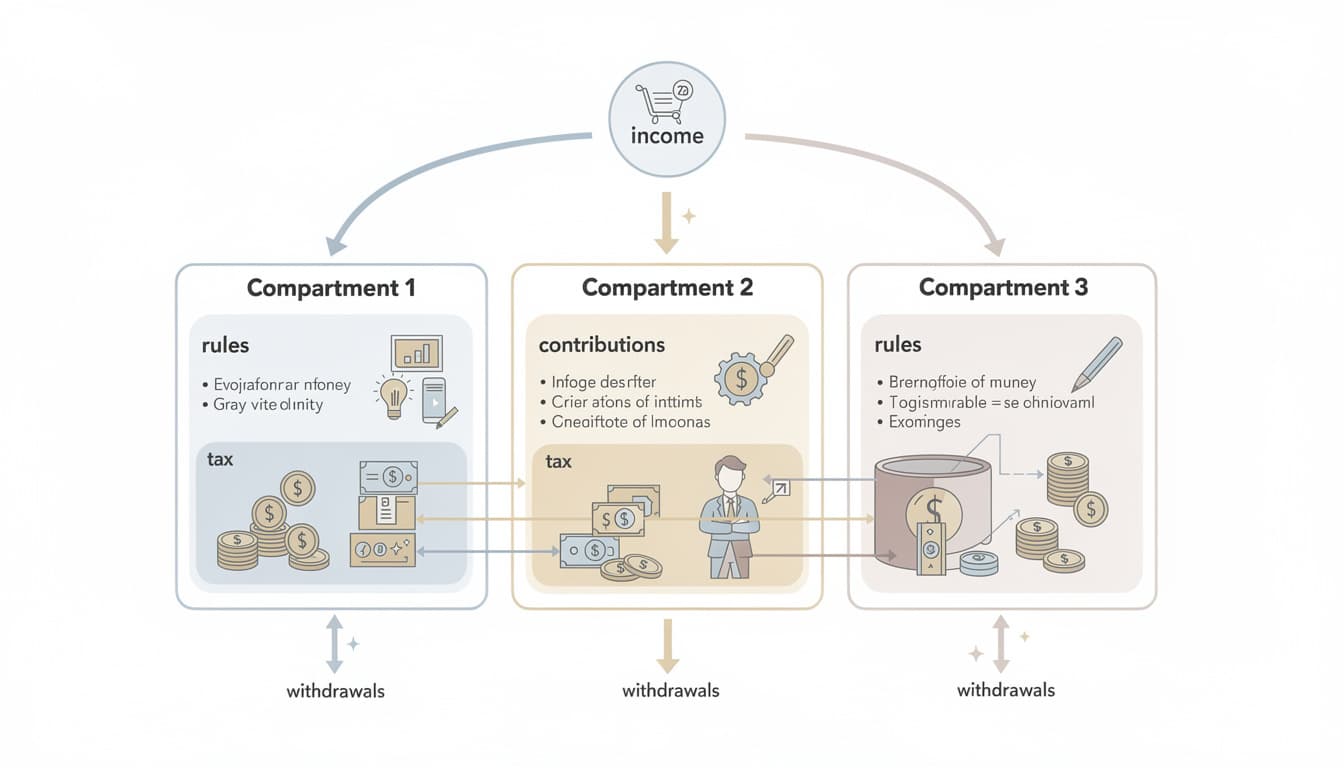
The PER works like a building with three sealed floors. Each floor has its own entry, behavior and exit rules. Confusing the three is like letting water escape through the wrong doors.
Compartment 1: your voluntary contributions, the real flexibility
It's the money you decide to contribute yourself, freely, without obligation. You can deduct it from your taxes (or choose not to — it's optional). At retirement, you can recover it entirely as capital, as an annuity, or a mix of both. No constraint, no mandatory locking in compartment 3. It's the floor of real advantages.
Compartment 2: employee savings, your employer's free money
This compartment groups profit-sharing, incentives, employer matching, or converted leave days into savings. The employer can offer you up to €7,690 per year (16% of PASS 2026) in matching — pure money without effort on your part. The same flexibility as C1 at exit. But beware: many employees don't know they can decide the destination of their annual profit-sharing.
Compartment 3: mandatory contributions, the retirement lock
This is where the trap lies. If your company has set up a PERO (mandatory PER, formerly article 83), your mandatory contributions go into C3. At retirement, this compartment is compulsorily paid out as a lifetime annuity. No capital, no flexibility. And you cannot access it in the case of purchasing a primary residence — unlike the other two compartments.
Since the 2026 finance law, there is another restriction: after age 70, your voluntary contributions are no longer deductible. This changes the strategy of “young retirees” who were still contributing beyond that age threshold. Saving is still possible, but without the tax advantage.
Deduct or not to deduct? The strategic question that pays off big 💵
It sounds abstract until you really think about it: every euro you contribute can take two different paths. And the choice you make today will have tax consequences for decades.
The logic of deduction: pay less today, give back on exit
You deduct your contributions: you get tax relief now (savings equal to your marginal tax rate × amount contributed). But in return, your capital is taxed at the income tax scale when you withdraw in capital. You exchange a deduction today for taxation tomorrow.
This trade-off is beneficial if your tax rate falls by retirement. If you are at 45% today and 30% at the time of departure, you gain €0.15 per euro contributed. On €40,000 annually for 20 years, that represents more than €120,000 in net savings.
Non-deduction: pay now, tax-free exit
You refuse the deduction: your capital is exempt from income tax at retirement (only the gains are taxed at the flat tax — prélèvement forfaitaire unique — of 30.4%). This is interesting if you are lightly taxed today, because the deduction would bring you almost nothing.
A micro-entrepreneur earning €40,000 a year sees his taxable bracket limited to the guaranteed minimum of €4,806 of deductible contribution. The deduction only brings him €1,442 in savings (at 30% TMI). It's better to keep that money invested without deduction, and let it come out tax-free at retirement.
The PER's tax mechanics are based on this duality: optimize according to your present and future situation. There is no one-size-fits-all answer. It's a personal calculation.
Deduction ceilings: employee, self-employed, micro-entrepreneur, three different worlds 📊
You chose to deduct. Now, how much can you actually contribute? The answer depends entirely on your professional status.
Employee: the simple 10% rule
It's linear: 10% of your professional income from the previous year, capped at 10% of eight times the PASS. In 2026, with the PASS at €48,060, your maximum ceiling is €38,448. Your guaranteed floor is €4,806 even if you earn little or are on parental leave.
A director earning €150,000 net can deduct €15,000 (10% of €150,000). An employee earning €25,000 net deducts €4,806 (the floor).
Self-employed: the double ceiling that multiplies possibilities
Non-salaried workers (liberal professionals, craftsmen, traders) benefit from a much more generous regime: 10% of their profit (capped at 8 PASS, i.e. €384,480) plus an additional 15% on the fraction between 1 PASS and 8 PASS. Result: a ceiling that can reach €88,911 in 2026.
A liberal doctor earning €200,000 in professional income can deduct: 10% × €200,000 = €20,000 (capped at 10% × €384,480 = €38,448) + 15% × (€200,000 − €48,060) = €22,791. Total: about €42,000 deductible per year. That's almost three times an employee at the same gross income. And this possibility extends over 10 years, then 15 years, thanks to the carryforward of unused ceilings.
Micro-entrepreneur: the pitfall of the allowance
This is where the story gets awkward. A micro-entrepreneur in services (50% allowance) with €70,000 in turnover actually has only €35,000 taxable income. His PER ceiling: 10% × €35,000 = €3,500. This is below the floor of €4,806, so the floor applies. The tax saving: less than €1,500 per year.
Many micro-entrepreneurs think they can contribute massively to their PER because they have high turnover. The flat-rate allowance drastically reduces their possibilities. It's a common disappointment.
Pooling ceilings: double your tax savings thanks to your spouse 👥
Here's a mechanism few couples exploit correctly, while it can represent an extra €10,000 to €15,000 of annual savings.
If you are married or in a civil partnership with joint taxation, your deduction ceilings are poolable. Your spouse without income (parental leave, unemployment, retired) generates each year a floor ceiling of €4,806 that accumulates. You can use these ceilings by having them contribute to their own PER, while deducting these contributions from your own income thanks to box 6QR on your tax return.
Concretely: you, an executive at 41% TMI, earn €120,000 (ceiling €12,000). Your spouse, without income (ceiling €4,806 per year). You tick box 6QR and contribute €16,806 in total. Savings: €6,890 immediately. And next year, you repeat. In ten years, without doing anything else, it's more than €68,000 of tax saved thanks to this pooling.
Many don't know this box exists, or mistakenly believe it complicates the process. It doesn't complicate anything — it even simplifies your life, since you make one transfer instead of two.
PER insurance or PER bank: the choice that determines your inheritance 🏛️
You decided the amount to contribute and the deduction method. One crucial decision remains: which type of PER contract to open? Because this decision will have major impacts on inheritance, wealth tax, fees and investment options.
PER insurance: the wealth envelope
It's a group insurance contract. You invest in a euro fund (guaranteed but low-yield, 2.5–3.5%) or in units of account (stocks, bonds, real estate, private equity). If you die before age 70, the PER insurance benefits from an allowance of €152,500 per beneficiary, then a levy on the surplus. It's massively advantageous for transmission.
Additionally, real-estate units of account (SCPI, OPCI) held in a PER insurance during the accumulation phase are exempt from wealth tax (IFI). It's an advantage that no other wrapper offers with such clarity. An IFI taxpayer can therefore hold €500,000 in SCPI within a PER insurance without worrying about property tax for 20 years.
PER bank: raw flexibility
It's a simple securities account. You invest directly: ETFs, stocks, bonds, cash. Management fees are often lower. But zero inheritance advantage — the PER bank fully enters your estate and is taxed like any inheritance. And IFI applies immediately.
The PER bank suits very experienced investors seeking true freedom of choice and who have no significant transmission issues. For others — the majority — the PER insurance is almost systematically preferable.
Fractional capital withdrawal: how to save €25,000 in tax 📈
You reach retirement. You have €300,000 in your PER. Now, how do you recover it without getting picked apart by the taxman?
The natural reflex: withdraw everything at once. It's a fiscal disaster. For example, a retiree with a pension of €30,000 (TMI 30%) who withdraws €300,000 in one go bumps into the 41–45% bracket. The tax on this single withdrawal: about €68,000. That's more than one-fifth of the amount evaporated.
The right strategy: spread it over 5 years. You withdraw €60,000 per year. Your income rises to €90,000 (€30,000 pension + €60,000 PER), which remains in the 30% bracket. Over five years, the total tax falls to about €42,000. Saving: €26,000 simply by spreading withdrawals.
This mechanism is called “fractional exit” and nobody talks about it enough. You have the legal right to spread the withdrawal of your capital without a fixed duration of five years — the text says “according to the contract's terms”.
The seven cases of early unlocking: when you can access your money before retirement 🔓
The PER is locked until retirement, admittedly. But this rule has seven exceptions. Knowing them reassures you about the real central risk of retirement savings: what if I need it tomorrow?
Life accidents: tax-free unlocking
Death of your spouse or civil partner, disability of category 2 or 3, over-indebtedness recognized by the specialized commission, end of your unemployment rights, cessation of activity following a liquidation judgment — these five cases allow a tax-exempt unlocking from income tax. You recover your capital (plus or minus gains) without income tax. Only social contributions apply.
Purchase of the primary residence: unlocking with tax
This is the sixth case, but it is different. If you buy your primary residence (first home, purchase after selling the previous one), you can unlock your C1 and C2, but not C3. And fiscally, it is treated like a normal retirement withdrawal: your deducted capital is taxed at the income tax scale, not exempt. You don't gain on taxes, but you get access to your money.
Minor PERs: an opportunity extinguished since 2024
For a few years, parents opened PERs in the name of their minor children to deduct contributions from their own tax — it was a clever legal arrangement. The 2024 finance law closed this tap. No more new PERs for minors, no more voluntary contributions on the old ones. Only the unlocking of sums already invested remains, with exit taxation identical to that of retirement.
The detailed operation of the PER in 2026 incorporates these new restrictions and opportunities. It is important to understand each case to preserve flexibility.
Exit taxation: what you will really pay 💰
You contributed €300,000 to your PER deducting your taxes for 30 years. Now that you retire, what is your actual tax bill on exit? The answer depends on three variables: did you deduct, do you exit in capital or annuity, and from which compartment does the money come.
Capital exit: the scale or the flat tax
If you deducted your contributions (deducted C1), your capital is taxed at the income tax scale — without the 10% allowance that pensions enjoy. Your gains are taxed at the flat tax (PFU) of 30.4% (12.8% IR + 17.2% social contributions up to the end of 2025, then 31.4% from 2026 following the CSG increase decided by the LFSS).
If you did not deduct (C1 capital non-deducted), your capital is exempt from income tax on exit. Only your gains are taxed at the PFU. It's clearly more favorable if you are lightly taxed at retirement.
Annuity exit: the age-based allowance
If you opt for a lifetime annuity, the tax depends on your age at the first payment. Between 60 and 69 years old, only 40% of your annuity is taxable. From 70 years, 30%. That's very advantageous compared to a capital exit.
Be careful however: if you had deducted your contributions, your annuity benefits from the pension regime (10% allowance), which partially restores the taxable base. If you had refused the deduction, your annuity falls under the “paid lifetime annuity” regime, which is significantly more favorable.
Transferring your old contracts to a modern PER: save on fees and gain flexibility 🔄
You may still have an old PERP or a Madelin contract sitting for years, with high fees and low returns. Transferring it to a new-generation PER can save you thousands of euros.
Why transfer?
Old products (PERP, Madelin, transferred article 83) had limits: mandatory minimal contributions, exit only as annuity, limited supports, hidden fees. A 15-year-old PERP with 1.2% annual fees is a drain. A modern PER at 0.5% UC fees is three times cheaper.
And above all, the PER allows a 100% capital exit, which was impossible before. If you had a PERP of €200,000 and planned to use it as capital, this flexibility is worth several tens of thousands of euros in tax savings thanks to fractional exit.
Transfer procedures
It's free after 5 years of holding (fees capped at 1% before). The deadline: two months maximum. You ask your manager to transfer your old contract to your new PER. No heavy administrative process.
One trap to check: did your old contract include a guaranteed mortality table for calculating the annuity? If so, you will lose it on transfer. Compare before deciding.
Tax reduction and wealth: the PER in your overall strategy 🎯
The PER doesn't live alone. It fits into an ecosystem of other savings wrappers — life insurance, PEA, securities account — each with its own advantages.
PER vs Life insurance: the duel of advantages
If your marginal tax rate is above 41%, the PER clearly wins: the massive deduction at entry offsets the tax at exit. But if your marginal tax rate is below 30%, life insurance becomes more interesting: no tax advantage at entry, but gentle taxation on exit after 8 years (19% if you withdraw before, 31.25% beyond). And above all, life insurance remains accessible and liquid if you need it before retirement.
For a significant overall estate with transmission stakes, many advisors recommend a mix: PER for aggressive deduction if the TMI justifies it, life insurance for liquidity and succession.
PEA vs PER for equities
If you dream of European stocks, the PEA offers complete tax exemption after 5 years. No deduction at entry, but zero tax at exit. It's simpler for the passive investor who projects long term and wants to avoid the PER's fiscal complexity.
But the wealth planner knows this: a PER insurance containing an equity fund can also exit 100% in capital benefiting from fractional withdrawal. The final difference often comes down to management fees and your personal discipline.
Common mistakes that cost thousands of euros ⚠️
After years of advising, here are the mistakes that keep coming up — and that could have been avoided with a clear understanding of how it works.
Deducting at a low TMI
A micro-entrepreneur early in their career at 11% TMI who deducts their PER contributions makes a costly mistake. The deduction yields 11%, but the capital exit taxes them at 30% — they lose money. It would have been better to refuse the deduction and let the capital exit tax-free.
Withdrawing everything at retirement
Many say “I've waited 30 years, now I want it all back.” Fiscally, it's a nightmare. They jump tax brackets, pay a fortune in tax, and deeply regret it. Spreading over 5 years would easily save €20,000 to €30,000 in tax.
Forgetting spouse pooling
A couple in which one earns well and the other very little (or nothing) leaves up to €4,806 of unused ceilings every year. By ticking box 6QR, they could deduct an extra €15,000 to €20,000 annually. Over 20 years, that's a missed gain of €300,000 to €400,000.
Choosing a PER bank for real-estate savings
An IFI investor who places SCPI in a PER bank sees them taxed immediately. If they had opened a PER insurance, these SCPIs would have been exempt from IFI during the accumulation phase — up to age 70. It's a loss of “non-tax” that can be colossal, sometimes €30,000 to €50,000 over time.
Ignoring underlying fees
A PER UC with 1.5% annual fees (expensive active UCITS) can cost you €200,000 of lost capital over 30 years compared to a PER at 0.5% with ETFs. That is, more than your initial investment.
The Service Public FR website details the PER rules and unlocking cases, to avoid disappointment.
PER and progressive retirement: an overlooked combination ⏰
Progressive retirement allows you to move to part-time from age 60 while receiving a fraction of your pension. Few know how this interacts with the PER.
Technically, progressive retirement is not an official case of PER early unlocking. But depending on your contract, the partial and provisional liquidation of your pension can open the right to a full PER unlocking. It's a gray area that depends on your manager.
Strategically, it's interesting: you are still working (activity income), so you can still contribute to your PER at a potentially lower tax rate than in full activity. Then once you take full retirement, you liquidate the PER in fractional capital. It's a triple optimization: final deductible contribution, plus progressive unlocking, without tax surprise.
PER and inheritance: transmit smartly, pay less 👨👩👧👦
You have heirs. Your PER insurance becomes a formidable transmission tool if you understand it.
Before 70: the €152,500 allowance per beneficiary
If you die before 70 with a PER insurance of €400,000 and two children beneficiaries, each receives €200,000. On that €200,000, the first €152,500 is exempt. Only €47,500 is taxed at 20% (up to €700,000 of capital), which is €9,500 of inheritance tax. It's incredibly advantageous.
By comparison, a standard inheritance of €200,000 to a child: allowance of €100,000, then progressive scale → minimum tax of €17,500. The PER saves €8,000 in duties.
After 70: relative tightening
From age 70, the PER's specific allowance (€30,500 total, all beneficiaries combined) applies — it's far less generous. And unlike classic life insurance (where only premiums paid after 70 are taxed, gains remaining exempt), for the PER, the entire capital + gains enter the tax base. It's a major trap many discover too late.
Morale: if you have a significant transmission stake, feed your PER insurance before 70, not after.
Beneficiary clause: the vital document
A well-drafted beneficiary clause can unlock strategies: usufruct/naked ownership splitting for the spouse and children, phased liquidation delays, etc. This is often where the real added value of expert advice lies.
And above all: a beneficiary clause remains valid after a divorce unless expressly modified. It's the costliest error — a PER that goes entirely to the ex-spouse instead of the children, due to failure to update.
Executives, expatriates, high incomes: tailor-made strategies 🚀
For certain profiles, the PER unlocks fiscal levers others don't suspect.
Self-employed manager (TNS): combine PER + PERO to exceed ceilings
A SARL or EIRL manager benefits from the increased TNS ceiling up to €88,911 in deductions. But they can also have a PERO as a manager, whose mandatory contributions are deductible in addition. It's a double envelope that allows massive contributions.
A manager earning €300,000 can contribute: PERin €88,911 + PERO mandatory contributions (8% of his share, capped), potentially €120,000 of annual deductions. That's a saving of €49,000 at 45% TMI — every year.
Reducing CEHR and CDHR: escaping surtaxes
If your income exceeds €250,000 (single) or €500,000 (couple), you pay the Exceptional Contribution on High Incomes — 3% to 4% extra. Your deductible PER contributions reduce your taxable income. Below the threshold, no CEHR. It's a fiscal “exemption” of €48,000 obtained for the price of a normal deduction.
Expatriation: the triple advantage
Are you moving to the United Kingdom? Keep your PER. Contributions will no longer be deductible during your expatriation (normal, you do not pay French taxes). But on your return, you benefit from a complementary ceiling multiplied by 3 in the first year — up to €153,792 of deductions. And above all, if you withdraw your PER as a non-resident, social contributions adjust — no IFI, no French CRDS.
Tax declaration: the key boxes so your deduction is counted 📋
Each spring, you must fill in your 2042 declaration. Here are the boxes that really matter.
Employee? Boxes 6NS and 6NT for your PER contributions. TNS? Boxes 6OS and 6OT for contributions already deducted from profit (trap: auto-fill often confuses 6NS and 6OS, correct it). Spouse pooling? Box 6QR must be ticked — without it, your spouse cannot “lend” you their ceilings.
And if you refuse the deduction (non-deduction option), you must inform your manager at the time of the contribution. No special box on the return, but it's irrevocable for the contract — you cannot change your mind afterwards.
The wealth planner knows: a simple omission of box 6QR costs €5,000 to €10,000 of tax per year for asymmetrical-income couples. Always check your return before sending.
Practical cases: four stories to embody the strategy 💼
Thomas, 42, executive at 41% TMI, married to Claire with no income
Thomas earns €120,000 net, pays colossal tax. His ceiling: €12,000. Claire generates €4,806 unused each year. By pooling (box 6QR), Thomas contributes €16,806 and deducts the whole. Saving: €6,890 the first year, renewed annually. Over 15 years, that's more than €100,000 of cumulative tax advantage, without any additional effort.
Sophie, 54, liberal doctor with €180,000 professional income (BNC)
Sophie, taxed at 41%, can deduct about €42,000 annually on her PER. She is completely unaware and contributes only €5,000 per year “because she didn't know.” In the 10 years before retirement, she could have deducted €420,000 instead of €50,000. That's a missed gain of €152,000 in tax savings — more than her car.
Julien, 35, micro-entrepreneur BIC services €60,000 turnover
Julien thought he could deduct €6,000 on his PER (10% of €60,000). Error: the micro-BIC allowance (50%) reduces his income to €30,000, his ceiling to €3,000, which is below the floor €4,806. He deducts the floor: €1,442 tax saving (at 30% TMI). It's very modest, but over 30 years, his PER still becomes €150,000 of retirement capital and €40,000 of cumulative tax savings.
Marie, 68, retired, €300,000 on PER (all contributions previously deducted)
Marie would like to recover her money. Single withdrawal: about €68,000 in tax (the majority of the capital). Fractional withdrawal over 5 years (€60,000/yr): about €42,000 total tax. Saving: €26,000. It's the equivalent of a year of her pension. She could have known this at 60 and anticipated it. It's a decision not to be taken on the fly.
Profil de l'auteur
Derniers articles
 Smartphones & Mobile Phones14 October 2026The loyalty penalty on your mobile bill: why staying put costs you more
- Family, Babies & Children5 October 2026Airline family seating fees: what the planned ban will change for parents
- Everyday Life & Society23 September 2026Consumer confidence index: what the monthly mood check on British households really measures
- Agency, Webmarketing & SEO31 August 2026SEO : a Google bug skews visibility statistics in AI results




Table of Contents

 work and reduce your taxes now with our complete and detailed guide.)