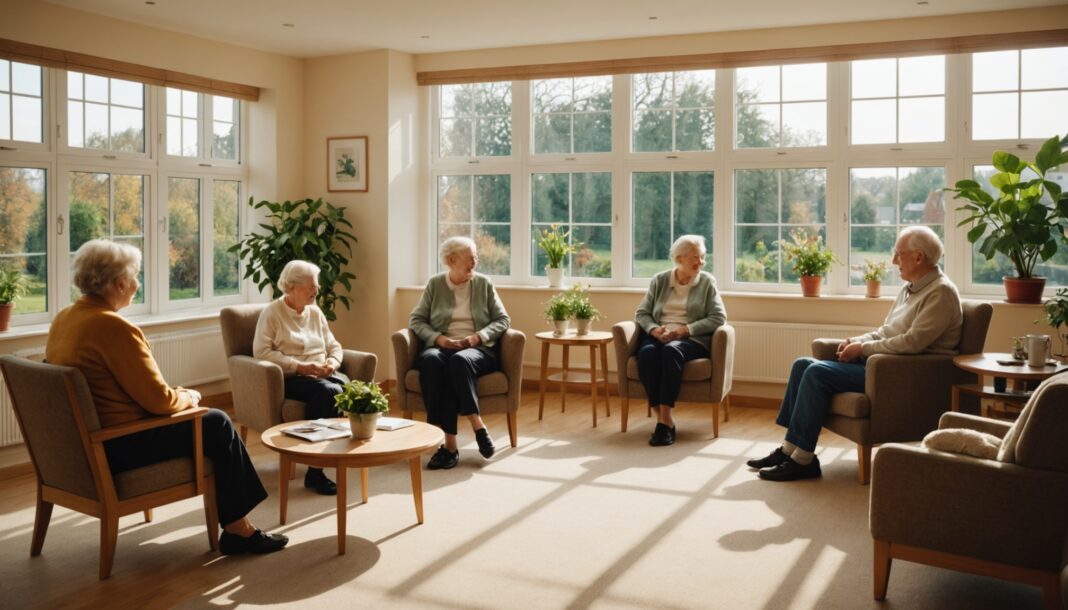
The word “EHPAD” (the French acronym for nursing homes for dependent elderly people) has long summed up, all by itself, the anguish of entering an establishment for the elderly. The government now wants to turn the page: establishments for the elderly will gradually be renamed “Maisons France Autonomie,” a change of name presented as the first building block of a broader reform of elder care, an issue we follow closely in our Retirement & Seniors section.
A New Name to Change the Image of Old Age
It was during a visit to the Pas-de-Calais region that the deputy minister in charge of Autonomy and Disability announced, in late April 2026, the creation of a label meant to replace the EHPAD acronym. The goal is to move these facilities away from the medicalized, anxiety-inducing image that has clung to them for decades, and to present them instead as places to live and pursue a residential pathway for seniors. The precise criteria for the label are to be finalized in the coming months, ahead of a national rollout targeted for around September 2027.
This semantic shift comes amid a climate in which the image of old age is already evolving, as alternative solutions develop, such as the new faces of active retirement or staying at home for as long as possible.
A National Conference to Build What Comes Next
The name change is only the visible part of a much broader undertaking. The Ministry of Labor and Solidarity has launched a National Autonomy Conference, whose work is expected to wrap up in fall 2026. Led by two co-rapporteurs who specialize in aging, with support from the CNSA (the French National Solidarity Fund for Autonomy) and the Directorate General for Social Cohesion, it brings together the State, local governments, sector professionals, advocacy groups, and representatives of older people.
Three steering committees are set to meet before the end of summer. The goal is twofold: to identify simplification measures that can be applied without going through legislation, and to prepare more structural reforms, at a time when demographic aging is weighing more heavily on public finances every year — an issue that overlaps with ongoing debates over retirement pension funding.
What This Actually Changes for Families
For residents and their loved ones, the renaming will not change rates or admission conditions in the immediate term. But several ideas are shaping the discussion:
- A stronger focus on staying at home, through home help and support services, mirroring changes already seen with the home autonomy service;
- A clarification of the residential pathway between autonomy residences, senior services residences, and medicalized care facilities;
- Work on the out-of-pocket costs borne by families, regularly cited as a major obstacle to entering a care facility;
- Better recognition of the benefits already available to seniors in everyday life, whether in mobility, such as the transportation discounts of the Senior Advantage Card, or supplemental income for those who keep working past the legal retirement age.
This last point ties directly into the question of combining work and retirement, as more and more seniors choose to stay active to supplement a pension they consider insufficient.
A Sector Torn Between Hope and Skepticism
On the ground, the announcement has been met with caution. Professional federations and labor organizations welcome the political awareness it reflects, but point out that a change of label alone will not solve the staffing shortages in tomorrow's Maisons France Autonomie, nor the funding needed for additional beds. Several advocacy groups insist that the reform's success will be judged by the resources that accompany it, not just by the new name displayed on facilities' facades.
The tight timeline — label finalized sometime in 2026, rollout targeted for 2027 — leaves little room for improvisation. The National Autonomy Conference will need to turn this momentum into concrete measures; otherwise, the name change risks remaining a symbol with no real effect on the daily lives of residents and their families, in a matter that touches on everyday life and society as much as on public finances.
Frequently Asked Questions
Will the EHPAD acronym disappear right away?
No. The “Maisons France Autonomie” label still needs to be finalized, with a rollout planned starting in September 2027. The term EHPAD will therefore remain in use in the coming months, including in regulatory texts.
Will the National Autonomy Conference lower the cost of care facilities?
That is not its primary goal. Its work, running through fall 2026, is aimed first at simplification and structural reforms; the out-of-pocket cost borne by families is among the topics discussed, but no pricing measure has been announced at this stage.
Who is taking part in this work?
The State, through the Ministry of Labor and Solidarity and the CNSA, is leading the effort with two co-rapporteurs specializing in elder care, alongside local governments, professional federations, and advocacy groups.
Sources
Ministry of Labor and Solidarity —
France Info —
Silvereco, the silver economy portal
Profil de l'auteur
Derniers articles
 Retirement & Senior Living24 November 2026Mothers' Retirement: What the New 2026 Pension Calculation Changes
- Home Appliances & Equipment24 November 2026Appliance Repair Bonus: The Little-Known Boost to Fix Rather Than Toss
- Nutrition, Diet & Weight Loss24 November 2026Intermittent Fasting: What the Science Really Shows About Weight Loss
- Restaurants, Drinks & Food24 November 2026Restaurant Trends Set to Reshape How We Eat Out




Trending now on legal streaming
FilmHeart of the Beast
SeriesCat's Eyes
This article was written with the help of artificial intelligence. Editorial policy
Table of Contents