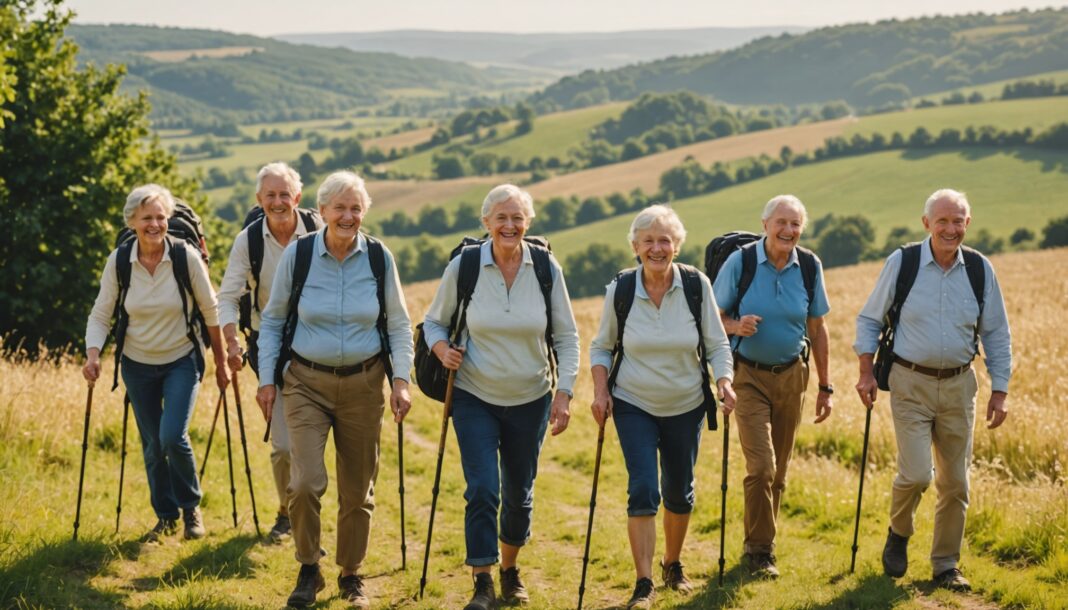
Dedicated sports clubs, senior centers that show “full”, off-season travel calendars: across France, retirement is changing shape. Far from the image of sedentary rest, a new generation of active seniors is asserting its wishes to local authorities, clubs and tourism professionals.
A growing generation
The movement is first supported by demography. France now has about 19 million people over 60, or 27.7% of the population. According to Insee, the 75–84 age group is the one that will grow the most over the next ten years: +49% between 2021 and 2031, due to the arrival at that age of the first baby‑boom generation. A demographic shift that mechanically pushes economic and associative actors to rethink their offerings for this public.
Travel, sport, clubs: what seniors really want
On the ground, initiatives are multiplying. The regional press reports the rise of “sport retirement” clubs open to active seniors, as well as senior centers offering sport, lectures and workshops, regularly full. A trend confirmed at the national level: according to an Ipsos study carried out for Alliance France Tourisme, 70% of French seniors traveled over the past two years, averaging 6.2 trips per year and an annual tourism expenditure of €2,230 — a level higher than that of 18–34 year‑olds.
Their priorities, however, differ markedly from other generations: accessibility, ease of travel and safety come first, far ahead of purely budgetary criteria. 72% of seniors surveyed favor off-season stays, a preference that could also keep them away from destinations most affected by overtourism, increasingly scrutinized by travelers.
A market and employers adapting
This rise of active seniors also feeds the famous “silver economy”. Home artificial intelligence, the rise of health-focused exercise: the sector, already estimated at several tens of billions of euros, continues to reinvent itself, as detailed recently in our article on the silver economy and the acceleration driven by AI and sport-health. The world of work is not escaping this evolution either: companies must now comply with new rules on the employment of seniors, a sign that longer working lives and longer lives overall are also reshaping organizations.
Result: between sports clubs turning people away, tour operators adapting their circuits and employers revising their practices, retirement in its 2026 version looks less and less like a pause, and more and more like a brand new full-fledged stage of life.
Frequently asked questions
How many seniors travel each year in France?
According to the Ipsos study for Alliance France Tourisme, 70% of French seniors traveled at least once over the past two years, with an average of 6.2 trips per year.
Why will the number of seniors increase sharply by 2031?
Insee explains this rise by the arrival at age 75 of the first baby‑boom generation, born after World War II, which causes the 75–84 age group to grow by 49% between 2021 and 2031.
What is the silver economy?
It is all the economic activities developed to meet the needs and wishes of seniors: health, sport, tourism, housing or home services, a rapidly growing sector driven by population aging.
Sources
- Ipsos – Senior tourism
- Insee – Seniors losing autonomy, population projections
- Alliance France Tourisme – Report on senior tourism
Profil de l'auteur
Derniers articles
 Weddings & Special Occasions13 September 2026Mariage : pourquoi la date choisie peut faire varier la facture de plusieurs milliers d'euros
- Development, Digital Marketing & SEO11 September 2026ChatGPT Ads en libre-service : ce qui change pour les annonceurs français
- Farming & Nature10 September 2026Seuils ICPE en élevage : ce qui change pour les agriculteurs
- Development, Digital Marketing & SEO7 September 2026Vibe coding : créer une application sans savoir coder, jusqu'où peut-on faire confiance à l'IA ?




This article was written with the help of artificial intelligence. Editorial policy
Table of Contents