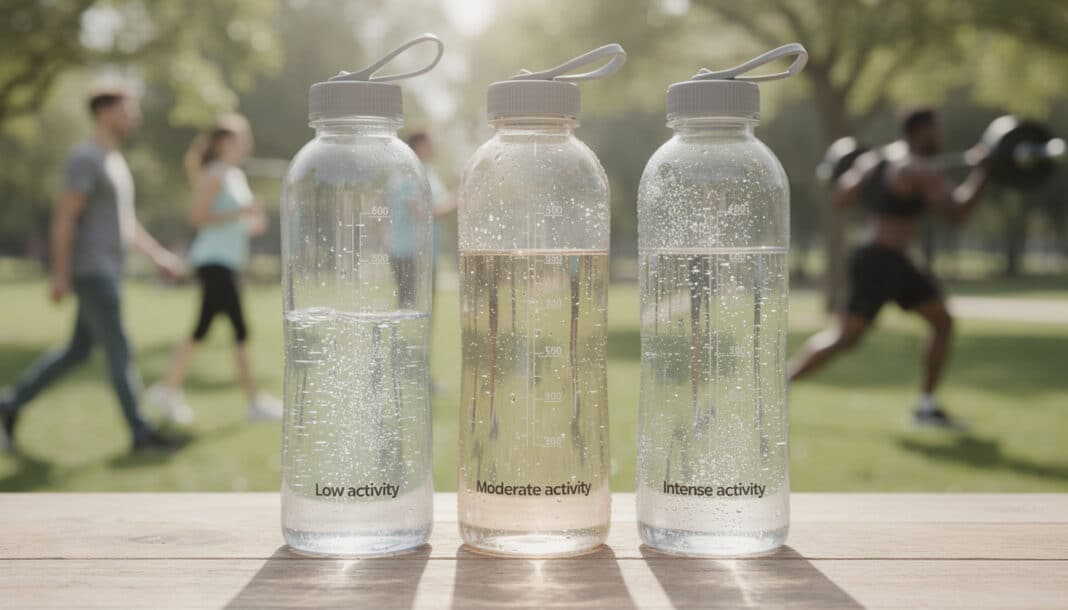
In short — Hydration is not a matter of chance. Our body, composed of 60% water, requires particular attention depending on our exertion, the temperature and our body type. Official recommendations suggest 1.5 to 2 liters daily, but this average masks a more nuanced reality: an athlete in full exertion does not have the same needs as a sedentary person. Discover how to adapt your water intake to your actual lifestyle, away from simplified messages.
💧 Water, that invisible thread that weaves our balance
There is a certain poetry in the way our body operates from a substance as simple as water. Every heartbeat, every thought, every movement relies on this fluid balance that we too often forget. Water transports nutrients to our cells, removes waste through the kidneys, regulates our body temperature and lubricates our joints — so many silent tasks that guarantee our well-being.
A mild dehydration, even imperceptible, is enough to impair our cognitive and physical performance. Those who have experienced it know how headaches appear without warning, how fatigue settles in stealthily. It's like a binding beginning to come apart: at first you see nothing, then suddenly the pages detach.
🔬 Why hydration goes beyond the simple act of drinking
Understanding hydration means accepting that our body is not a uniform machine. Each of us has a unique hydration signature, determined by our weight, our metabolism and our activity level. According to the European Food Safety Authority, total water needs are around 2.5 liters for a man and 2 liters for a woman, all sources combined — including fruit, vegetables and beverages.
But here's the detail that changes everything: about 20 to 30% of these needs come from our diet. That leaves between 1.5 and 2 liters of fluids to absorb directly. That would seem simple, wouldn't it? And yet, that conceals a much more complex reality.
🏃 Adapting your hydration to the intensity of your effort
When you engage in physical activity, the situation changes radically. Sweat loss becomes a major factor, and with it a fluid loss that the body must quickly compensate for to maintain performance. A jogger who barely sweats does not have the same needs as a marathon runner or someone working out in the gym.
The secret lies in anticipation. Drinking regularly and lightly during exercise prevents the energy crash that appears after an hour of exertion. It's a lesson in balance: too little, and cramps begin to show up; too much, and digestive discomfort crashes the party.
📊 The variables that modulate your actual needs
Three factors precisely determine your optimal daily amount of water. The first is your body weight: a simple rule is to multiply your weight in kilograms by 35 milliliters. A 70 kg person would therefore need about 2.45 liters. The second is exercise intensity: every 30 minutes of moderate effort adds 400 to 500 milliliters to this baseline.
The third factor is environmental. A hot day, high humidity, a particular altitude — all conditions that accelerate dehydration. In the middle of summer, during a heatwave, your needs can increase by 30 to 50%.
To make sense of this personalized equation, calculate your precise hydration needs based on your unique profile. It's the difference between guessing and knowing.
⚠️ The signals your body sends you
Our body has a silent but eloquent language. Dehydration manifests as dull headaches, unexplained fatigue, difficulty focusing your attention. The mouth becomes dry, dizziness appears when standing up too quickly, and urine volume decreases noticeably. Observe the color of your urine: a pale yellow indicates proper hydration, while a dark yellow raises the alarm.
In older people, this sensation of thirst dulls with age, exposing them more to risk. History reminded us harshly: during the summer of 2003, a record heatwave caused 15,000 excess deaths in France, a significant portion of which were linked to dehydration among the elderly. It's a reminder that fluid balance is not a question of comfort, but of survival.
🚫 These drinks that deceive you
A common mistake is to believe that every drink hydrates in the same way. Yet sugary sodas, alcohol and highly caffeinated drinks do not replace water. These have a clear diuretic effect — they dehydrate you more than they hydrate you. They also add unnecessary calories or disturb your electrolyte balance.
Water remains liquid gold. Simple, straightforward, unadorned.
💪 Optimizing sports performance through hydration
Athletes have long known that sports performance depends directly on the quality of their hydration. A fluid loss of 2% of body weight is enough to reduce strength, endurance and resilience. It's invisible, but formidable. During intense efforts, the heart must compensate: it speeds up, delivering less oxygen to muscles that are increasingly deprived.
The winning strategy is to drink before, during and after exercise. Don't wait for thirst — by that time, it's already too late. Before a session, consume 400 to 600 milliliters two to three hours beforehand. During, set your intake to 150 to 250 milliliters every 15 to 20 minutes, depending on your intensity.
To understand how to integrate this vigilance into your daily life, explore how active recovery can improve your overall hydration and your post-exercise well-being.
🎯 Create cues to drink effortlessly
Consistency trumps intensity. Adopt simple gestures: a large glass on waking to kickstart your metabolism, one before each meal, one during your morning break, another in the afternoon. These five to six glasses add up without feeling burdensome. It's the power of ritualization — a concept dear to those who work with their hands, who know that repeating the gesture makes discipline invisible.
Some find it useful to equip themselves with a reusable bottle, not only for ecology, but also to turn hydration into a deliberate act rather than an obligation. Others discover that a smartwatch can intelligently remind you of your hydration needs without becoming intrusive.
🌡️ When the environment comes into play
In summer, ambient temperature becomes an invisible partner in your hydration. Each extra degree intensifies sweating and, with it, fluid loss. In tropical climates or on sunny vacations, your hydration recommendations can double. Even without physical effort, sitting in the shade, your body evaporates more water than in winter.
Altitude plays a similar role. In the mountains, drier air speeds up skin evaporation and breathing, increasing your needs without you really realizing it. Experienced hikers have learned this the hard way: drink more at 2,000 meters altitude than at sea level.
📈 The numbers to remember
To summarize in key figures: the baseline is between 1.5 and 2 liters daily for a sedentary person in a temperate climate. Each hour of moderate activity adds 500 milliliters. In hot or intense climates, add 25 to 50% more. A pregnant or breastfeeding woman will add 300 to 500 milliliters to her usual needs.
These figures are not dogma, but reference points. Your reality depends on you — your constitution, your metabolism, your habits.
Explore further at the fundamentals of hydration and its daily impact to refine your personal understanding.
🧠 The cognitive impact of good hydration
What few people understand is that hydration first affects your brain. A 2% dehydration is enough to impair concentration, slow your reflexes and reduce your decision-making ability. Office workers, students, creatives — all those whose work demands mental sharpness — should consider water as a performance tool as much as a biological necessity.
Have you noticed how a day without enough water often ends with migraines or disproportionate mental fatigue? That's because your brain, composed of 75% water, suffers before you even notice. A few sips are often enough to restore mental clarity within minutes.
🔄 Hydration, a process, not a destination
There is no single answer valid for always. Your body changes with the seasons, with your age, with your commitments. The summer athlete does not have the same needs as the same athlete in winter. The pregnant woman must readjust her consumption. Someone who ages must try harder since the sensation of thirst decreases with the years.
That's why the amount of water you need to drink remains a question to ask yourself regularly, an attention to cultivate. Not a habit that lulls you, but an awakened awareness of what your body demands. Like in the bookbinding workshop, where each project requires a personalized approach, each day of your life deserves that same intentionality toward yourself.
Profil de l'auteur
Derniers articles
 Electricity, Gas & Energy14 September 2026Gaz et électricité : ce que la hausse des tarifs va changer sur votre facture
- Agency, Webmarketing & SEO12 September 2026Fusion Omnicom-IPG : ce que la plus grande agence de publicité au monde change pour les marques
- Retirement & Senior Living10 September 2026Carte Avantage Senior SNCF : comment voyager moins cher en train après 60 ans
- Tech & Multimedia8 September 2026Objets connectés : la fin de la 2G et le nouveau Data Act vont rebattre les cartes




Table of Contents