


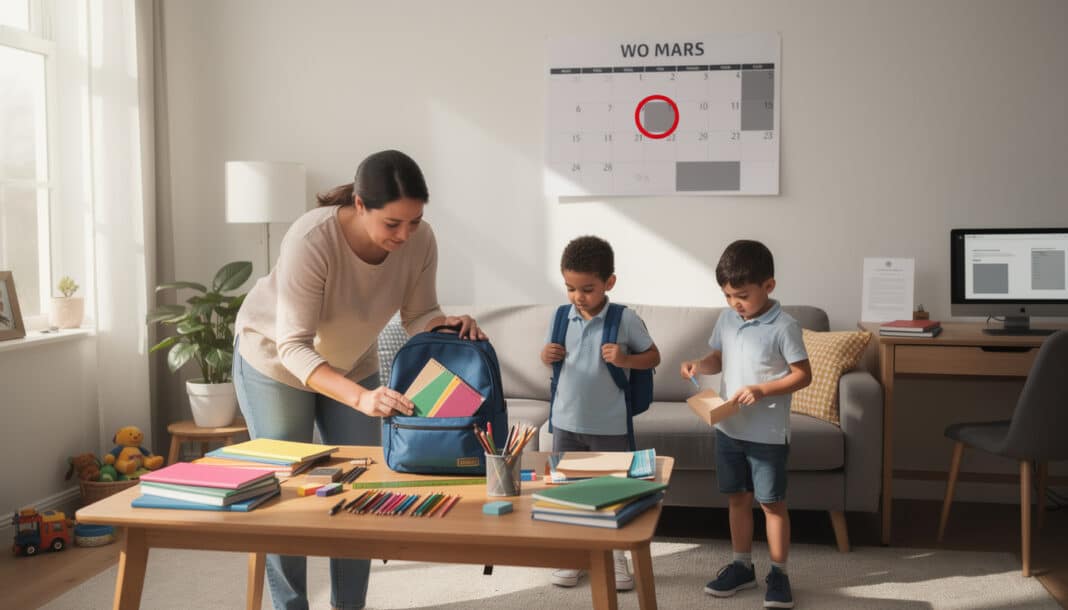
In short : The back-to-school allowance (ARS) is a financial aid intended for families with school-aged children between 6 and 18 years old. Its payment depends on compliance with strict conditions: the child's age, their schooling in a recognized institution, and above all the family's income ceiling. For the 2026 school year, the incomes taken into account go back to 2024, and the ceilings vary according to the number of dependent children. A differential allowance may be granted if your income slightly exceeds the authorized threshold. The CAF or the MSA generally pay this allowance in August, providing valuable support for school supplies, equipment and materials.
Who can benefit from the back-to-school allowance in 2026?
The back-to-school allowance is aimed at families that combine several elements: having at least one child, that the child be between 6 and 18 years old, that they be enrolled in a recognized school or at the CNED, and finally meeting an income ceiling. This aid works like a redistribution mechanism, like a delicately folded paper chain that links every link of a family to tangible support.
Apprentices can also benefit from it, as can those cared for by a specialized institution. It is different for children followed by child welfare services: the allowance is paid to them into a blocked account, not directly to the parents. Children schooled at home, without an institutional structure, unfortunately remain ineligible.

Age and schooling criteria
For this year's school start, your child must have been born between 16 September 2008 and 31 December 2020 inclusive. This strict age window ensures that the aid effectively targets youngsters in an active learning phase. A child who would be 19 at the time of the school start cannot claim this school financial aid, even if they continue their studies.
Schooling must be effective and verifiable. For teenagers aged 16 to 18, an annual declaration of schooling or apprenticeship remains mandatory. This is a point of vigilance for families: an administrative oversight can result in non-payment.
The exception for apprentices and their constraints
An apprentice under 18 can receive the ARS, but with an important limit: their monthly remuneration must not exceed 55% of the SMIC. This clause protects the spirit of the allowance, intended for families with limited incomes, not to support young workers with high incomes.
Income conditions: a fragile balance
Access to the back-to-school allowance is based on a system of income ceilings that varies according to family composition. These thresholds recall the meticulous constraints found in bookbinding: every detail matters, and one exceeded measure compromises the whole.
For the current year, the incomes examined are those declared in 2024 (year N-2). This delay allows the administration to have reliable data, but it also introduces a lag: a family whose situation has improved since may be refused aid based on outdated figures.
Ceilings to know by family size
For a family with one child, the ceiling is set at €28,956 of annual income. With two children, it rises to €35,638, then €42,320 for three children and €49,002 for four children. Each additional child increases this ceiling by €6,682.
These amounts are revalued each year to account for inflation and economic developments. The checking of updated benefits and thresholds remains the best way to verify your precise situation.
Which incomes are actually counted?
The administration takes into account your net categorical income, reduced by deductible expenses and any tax allowances. This means your tax return is used as the basis for calculations, with certain technical adjustments. Family benefits you receive are not subtracted; replacement incomes such as unemployment benefits are, according to specific rules.
One point deserves attention: if you are self-employed or a farmer, your professional expenses reduce your taxable income, which can place you below the ceiling even if your gross turnover exceeded it.
The differential allowance: when you slightly exceed the threshold
If your income slightly exceeds the applicable ceiling, you are not automatically excluded. A mechanism of differential allowance allows you to receive part of the aid, reduced proportionally to the gap. This system prevents a sudden and abrupt break.
Suppose a family with three children: the standard ceiling is €42,320. If their income reaches €42,500, the increased ceiling includes this amount plus the total of the ARS they would have received while remaining below. The difference between this increased ceiling and their actual income determines the differential allowance paid, always less than the full standard aid.
Knowing the payment date and administrative procedures
Every year, millions of families await the ARS payment date with interest. In 2025, the payment was made on 19 August in metropolitan France as well as in the overseas departments (Guadeloupe, Guyane, Martinique). For 2026, the exact dates have not yet been officially announced, but tradition holds that the payment occurs before the start of the school year, generally in August.
The CAF or the MSA manage this payment. If you fall under the agricultural scheme or are an agricultural entrepreneur, it is the Mutualité sociale agricole that handles your ARS application file. For private sector employees and civil servants, it is the Caisse d'allocations familiales.
Check your eligibility easily
Rather than getting lost in calculations, a simulator gives you a reliable answer in a few minutes. You enter your number of children, their ages, your professional situation and your 2024 income. The tool then indicates whether you are eligible and offers an estimate of the amount to be received.
This online procedure avoids mistakes and spares you a phone call or an administrative letter. It's a precious time saver when you know that back-to-school season rhymes with urgency and unexpected expenses.
Amounts paid according to the child's age
The allowance varies according to age. A child aged 6 to 10 does not receive the same sum as a teenager aged 15 to 18. These differences reflect the real cost of supplies and equipment, higher for a high school student than for a primary school pupil.
For a single parent, the amounts are approximately €423 for the youngest and €462 for the oldest. These figures are indexed each year and deserve verification with your family benefits agency or the official site for consultation of the 2026 thresholds and amounts.
Particular situations and frequently forgotten points
Certain family configurations raise specific questions. A child who repeats a year remains eligible: repeating a year does not cancel the right to the allowance, as long as the child remains enrolled and the age and income conditions are satisfied.
A child placed in child welfare services or hospitalized in a medical facility receives the allowance into a blocked account, frozen until their majority or circumstances that would justify unlocking it. It is a protection: the money is ensured for them, without risk of diversion by the responsible third parties.
Children with disabilities or in specialized studies
Children cared for in a specialized educational institution benefit from the allowance in the same way, subject to the general age and income conditions. Their disability status does not change the eligibility rules.
For young people in IME (Institut médico-éducatif) or in ITEP (Institut thérapeutique éducatif et pédagogique), the ARS is paid personally and placed in a blocked account. This protective measure recognizes their particular vulnerability.
Protection against seizures and recoveries
The law generally protects family benefits from any seizure by a creditor. However, this protection is not absolute: a seizure can occur for debts of alimony (child support) or arrears of canteen fees. These exceptions aim to prioritize the child's well-being over other claims.
The back-to-school allowance, a gesture of solidarity that deserves its place
By connecting so many families to tangible aid, the back-to-school allowance traces a thread of trust and equality. It recognizes that school, the anchorage of childhood, must remain accessible to all, regardless of the parents' financial circumstances. Each year, more than 5 million children and 3 million families benefit from it.
This aid, paid once a year in August, structures family budgets and eases the anxieties of September. It also says something about our time: that parents with modest incomes deserve support, and that public investment in education begins by facilitating material access to school.
Profil de l'auteur
Derniers articles
 Smartphones & Mobile Phones14 October 2026The loyalty penalty on your mobile bill: why staying put costs you more
- Family, Babies & Children5 October 2026Airline family seating fees: what the planned ban will change for parents
- Everyday Life & Society23 September 2026Consumer confidence index: what the monthly mood check on British households really measures
- Agency, Webmarketing & SEO31 August 2026SEO : a Google bug skews visibility statistics in AI results




Table of Contents

 for this year.)