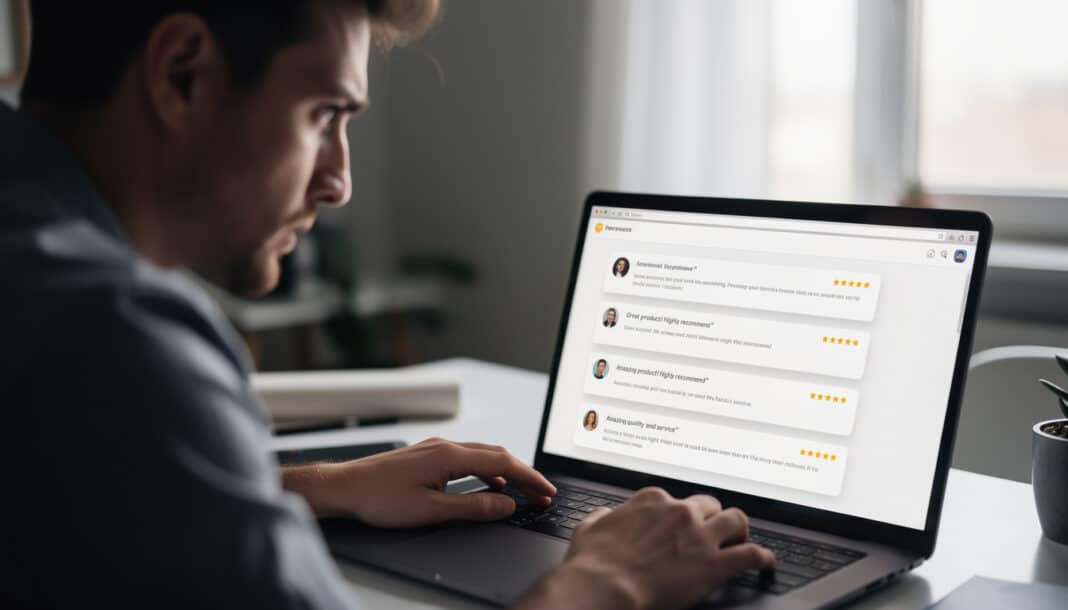
In 2026, 92% of French people consult online reviews before making a purchase, making it the primary decision criterion for consumers. Yet between 15 and 30% of these reviews are fake or manipulated. How can you quickly identify a fraudulent comment? This article reveals the warning signs to spot in under 30 seconds to protect your online trust.
Key points of the article:
- 🔴 Between 15 and 30% of reviews posted online are fake or manipulated
- ⚠️ Fake reviews come from several sources: paid providers, AI bots, competitors or even the companies themselves
- ✅ Five signals allow you to spot a fake review in under 30 seconds: suspicious profile, marketing-style writing, publication spikes, lack of nuance and inconsistency with other reviews
- 🛡️ The DGCCRF carried out more than 3,200 checks against fake reviews in 2025
- 💡 Platforms use AI, purchase verification and human moderation to fight fraud
💥 Why fake reviews rule the internet and how they fool you
Fake customer reviews are not the result of chance. They serve very concrete objectives: to manipulate your perception to push you to buy from a company or, conversely, to steer you away. This trap of digital commerce has grown with the democratization of AI technologies and cheap review-writing services.
Imagine a small online clothing shop just starting out. Rather than patiently waiting for the first customer reviews, the owner decides to buy about fifty from a specialized agency. In one week, their rating jumps from 2.8 to 4.7 stars. Consumers are misled, honest competitors are disadvantaged, and the market gradually deteriorates.
The categories of fake reviews vary according to malicious intent: 🎯 paid reviews are written by paid providers, often based abroad; 🤖 automated reviews are generated by bots or AI tools capable of producing convincing text; 💝 incentivized reviews offer discounts or gifts in exchange for a positive comment; 👊 disguised competitor reviews intentionally target a rival's reputation; and finally, self-reviews, where the company itself or its close associates publish praise without revealing their affiliation.
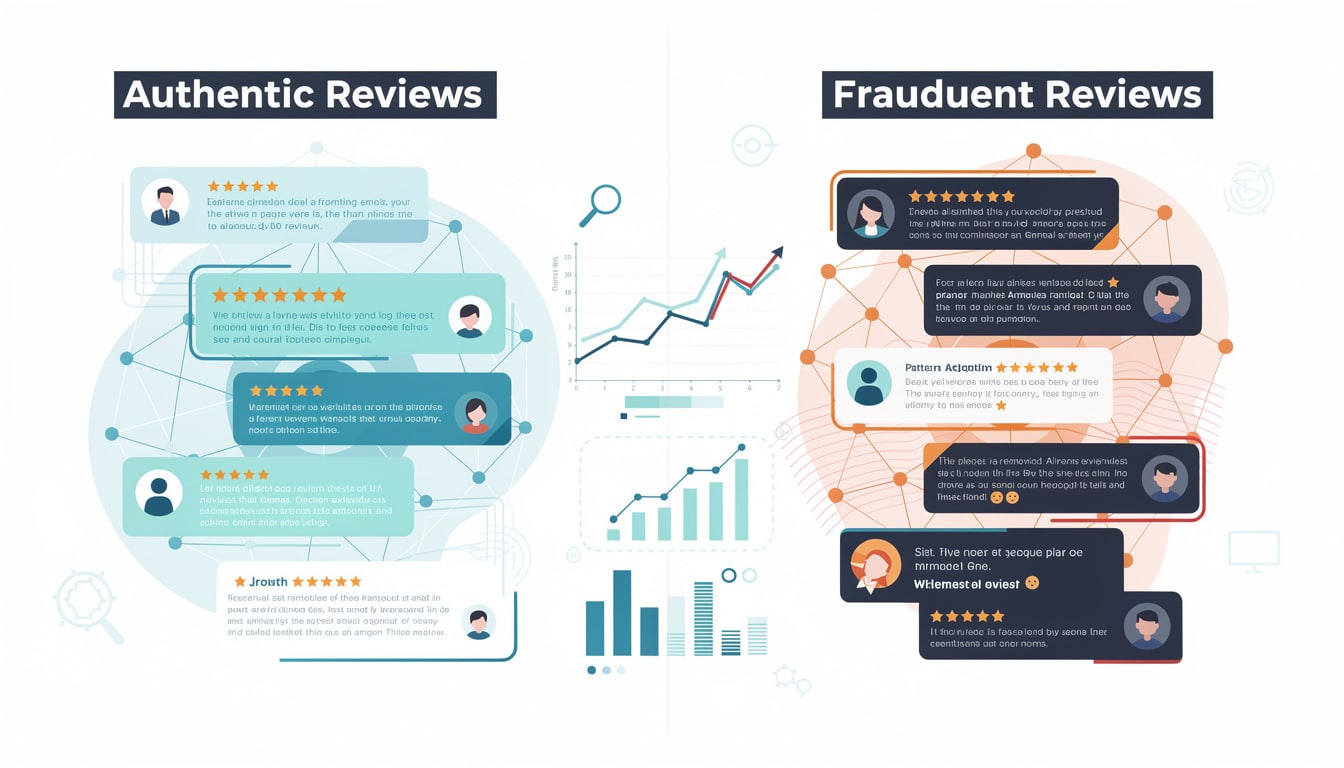
🔍 The five warning signs to detect in under 30 seconds
Developing a critical eye toward online reviews does not require specialized training. You just need to know the recurring signals of fake reviews. Here’s how to identify them quickly.
1️⃣ Examine the author's profile: a revealing history
A user who has posted only a single review, especially if it is extremely positive or negative, deserves scrutiny. On most platforms, you can view a writer's full history. A credible profile typically shows multiple comments, varied ratings, and some consistency in the types of businesses reviewed.
Ask yourself this question: has this user rated other restaurants, shops or services? If the answer is no, you are facing an account created specifically to leave a review. This behavior is one of the most reliable fingerprints of manipulation campaigns. Discover how to verify review authenticity with specialized tools.
2️⃣ Scrutinize the writing style: the marketing tone that gives it away
Fake reviews share a distinct digital signature. They overuse excessive marketing vocabulary: “exceptional”, “incredible”, “the best I've ever seen”, “complete transformation”. These expressions sound artificial because they are. A real consumer describes their experience in an organic way.
Another troubling indicator: the repetition of the company's full name several times in a short text. Real reviews include the name once or twice, naturally. Finally, examine the structure: fake comments are often syntactically too perfect, without the small hesitations or awkward formulations that characterize a real customer.
3️⃣ Analyze the publication timeline: spot suspicious spikes
Companies that order reviews in bulk create publication spikes that are easy to detect. If a pizzeria usually receives two to three reviews per month and suddenly accumulates 50 in one week, all with 5 stars, you are facing obvious manipulation. The DGCCRF regularly warns about these deceptive practices.
Also compare periods: if positive reviews are concentrated over three specific weeks while recent feedback is critical, an artificial marketing operation likely took place.
4️⃣ Look for nuance: the absence of criticism is a red flag
A 100% positive review, long and detailed, without a single reservation, is statistically unlikely. Research in consumer psychology shows that real customers mention on average 1.3 weak points for three positive aspects. Why? Because no service is perfect.
A restaurant may have excellent pasta but slightly slow service. A hotel may offer a beautiful view but have thin walls. This authenticity is missing from fake reviews generated by algorithms or by providers under pressure to produce many quickly.
5️⃣ Compare reviews across platforms: inconsistency is revealing
A stark discrepancy between ratings on different sites is a major signal. If a brand shows 4.9/5 on one platform but only 2.5/5 on another, one of those sources is manipulated. Check reviews on multiple sites: Google, specialized platforms, forums. This triangulation will give you a reliable view.
🎯 Advanced techniques to unmask online fraud
Beyond visual observations, more sophisticated methods can unmask fraudulent comments. Savvy consumers benefit from mastering them.
Decode metadata: the digital DNA of fake reviews
Every review leaves traces. Time of posting, country of origin, purchase verification, account age: these data tell a story. A review posted at 3 a.m. by a profile based in Southeast Asia for a small local French business, with approximate French, ticks several boxes. Also consider whether the purchase was verified by the platform: it is one of the most reliable guarantees of authenticity.
Spot text patterns: the signature of mass production
When a company orders a hundred reviews from a cheap provider, efficiency trumps originality. Writers recycle formulations. Look for identical expressions across several reviews, similar sentence structures, or repetitive spelling mistakes. If three comments use exactly the same unusual phrasing or the same pun, they probably come from the same source.
Consult specialized verification sites
Fake review detection experts offer detailed guides and tools to analyze the credibility of comments. These resources assess suspicious profiles, coordinated behaviors and textual anomalies that a human might overlook.
🛡️ How platforms fight fraud in 2026
The web giants do not remain passive. They invest heavily in the fight against fake reviews, deploying sophisticated technologies to protect consumer trust.
Artificial intelligence is the first line of defense. Machine learning algorithms analyze each review in real time, detecting statistical anomalies, suspicious textual similarities and unusual behaviors. A system can identify a review written by the same bot as a hundred others in a few milliseconds.
Purchase verification remains the most reliable method. Only users who have actually bought or used the service are allowed to post. This barrier eliminates the majority of fake reviews bought from external agencies. Human moderation complements these systems: teams review reported or flagged comments.
In France, the AFNOR NF Z74-501 standard governs the entire process. Certified platforms adhere to a strict specification including the collection, moderation and restitution of reviews. This certification becomes a mark of quality for informed consumers.
📊 Numbers that attest to the scale of the problem
Recent data illustrate why vigilance is necessary. The DGCCRF launched more than 3,200 inspections in 2025 related to deceptive commercial practices involving online reviews. The global market for fake reviews exceeds €4.5 billion annually. These figures testify to a heavily contaminated ecosystem.
On the consumer side, 82% say they have doubted the authenticity of a review at least once. The most affected sectors vary: hospitality and restaurants suffer the most with 38% problematic reviews, followed by e-commerce (27%) and personal services (18%). Consumer associations regularly warn about this trend.
Legal consequences for fraudulent companies are severe: fines up to €300,000 and up to two years' imprisonment for deceptive commercial practices. Despite this, the phenomenon persists, because short-term gains attract offenders.
🚨 Faced with a suspicious review: actions to take
Identifying a fraudulent review is only the first step. You have the power to act to clean up this ecosystem. All serious platforms provide a report button. In a few clicks, you alert moderators. Processing times vary, but the most responsible respond within 48 hours.
You can also report deceptive practices directly to the French authorities via SignalConso, the government platform dedicated to this. This process creates an official record and encourages investigations. Finally, the best antidote to fake reviews remains real ones. Share your own experience online, sincere and detailed, to help other consumers.
🔐 Tools and resources to validate authenticity
Several digital solutions make it easier to evaluate review reliability. Que Choisir offers an innovative tool to detect fraudulent reviews, developed in collaboration with experts. Browser extensions analyze reviews in real time and assign reliability scores to products and services.
Specialized verification sites scrutinize review profiles to detect coordinated behaviors: account creation on the same day, burst review posting, or use of VPNs to mask origin. These technical clues often confirm what your instinct already suggests. Comprehensive guides teach you how to recognize fake Google reviews and other major platforms.
💡 Protect your judgment: the five essential reflexes
Developing a critical eye for online reviews is a lasting investment. Here are five reflexes to develop:
✅ Always check the author's profile: their review history, consistency, and account age.
✅ Be wary of reviews that are too perfect or too destructive: reality lives in nuance.
✅ Compare sources: consult multiple platforms for a reliable overview.
✅ Observe timelines: suspicious publication spikes reveal manipulations.
✅ Favor certified platforms: those that verify purchases and enforce strict standards offer better protection.
By developing these habits, you not only protect your wallet: you actively participate in cleaning up digital commerce. Every fake review reported, every real review shared, helps restore trust in an ecosystem that needs it.
Profil de l'auteur
Derniers articles
 Smartphones & Mobile Phones14 October 2026The loyalty penalty on your mobile bill: why staying put costs you more
- Family, Babies & Children5 October 2026Airline family seating fees: what the planned ban will change for parents
- Everyday Life & Society23 September 2026Consumer confidence index: what the monthly mood check on British households really measures
- Agency, Webmarketing & SEO31 August 2026SEO : a Google bug skews visibility statistics in AI results




Table of Contents