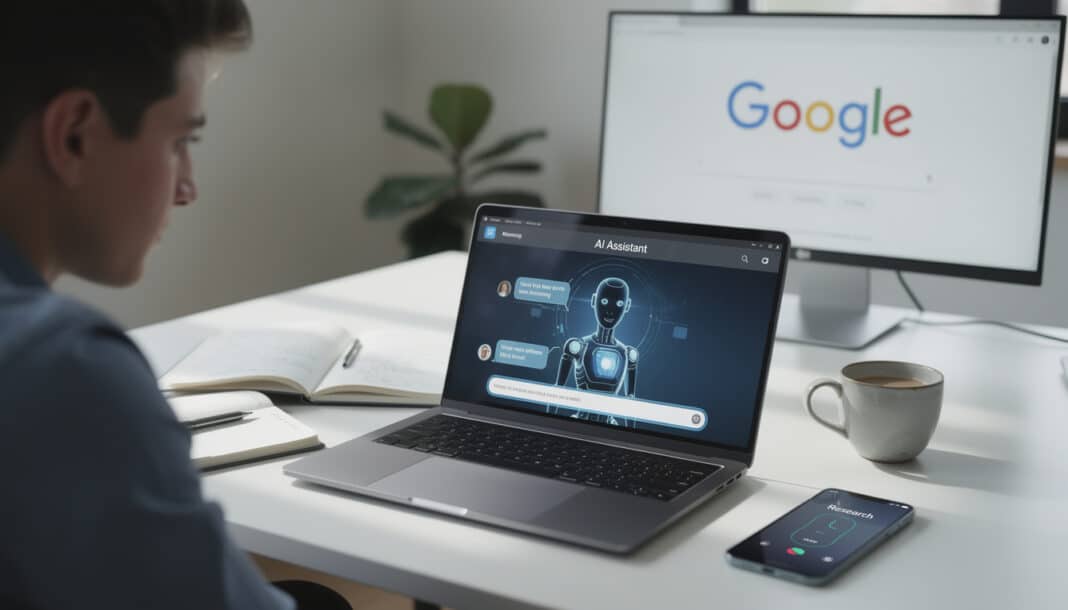
The landscape of online search is undergoing a silent but irreversible shift. For several years, AI-powered search engines have been gaining ground against Google, which has nevertheless reigned unchallenged for three decades. ChatGPT now handles around 800 million searches per month, while younger generations are gradually abandoning lists of links in favor of synthesized, contextualized answers. This shift is not a mere trend: it's a profound overhaul of our relationship to information, of the way we search at the moment we decide.
In short: Google retains its dominance with 90% market share and 16.4 billion searches per day, but AI platforms show a 527% annual growth rate and convert 4 to 5 times better. Young adults (18-24) use ChatGPT almost as much as Google. The 2026-2028 window will be decisive: companies must prepare their visibility in this fragmented ecosystem now in order not to disappear from the radar. 🎯
Why traditional search shows its limits against AI assistants 🔍
For twenty-nine years, Google shaped the way we search. Type a question, get ten blue links, click and compare. It was efficient, but exhausting. This mechanism places a considerable cognitive load on the user: navigating between multiple pages, assessing their credibility, mentally synthesizing the information, then deciding. Each additional click represents friction, an opportunity to give up.
AI-powered search engines work differently. You ask a natural, conversational question. The AI processes multiple sources simultaneously, extracts the relevant elements and delivers a structured answer, often enriched with citations. There is no longer a list to scan, just an intelligent synthesis that directly responds to your intent. It's faster, clearer, more human in its construction.
This fundamental difference explains why daily searches are gradually migrating. Someone searching for “best project management software for remote teams” will get about ten disparate results on Google. On ChatGPT or Perplexity, they will receive an answer that compares the solutions, cites the strengths and weaknesses of each, then recommends one. The path to decision shortens dramatically.

The conversion advantage: why AI converts 4 to 5 times better
The numbers are telling. AI platforms show a conversion rate four to five times higher than Google's. This is not a marginal improvement; it's a gap. Why? Because a synthesized answer reduces decision friction. A user who gets a complete analysis in three seconds rather than a list to explore for three minutes is more likely to take action.
This efficiency rests on a paradigm shift: optimization for user satisfaction rather than for ad monetization. Google, whose business model depends on ads, must balance relevance with the space given to sponsored content. AI platforms, without that advertising revenue constraint, optimize purely for the quality of the answer. It's a structural difference that is widening.
The demographic trajectory: how younger generations are reshaping search 📱
The data reveal a dizzying generational shift. Among 18–24-year-olds, ChatGPT reaches 97% of Google's usage — an almost unthinkable parity two years ago. For 25–34-year-olds, the ratio rises to 65–70%. For 45–54-year-olds, it falls to 20–25%. This is not a random distribution: it's the signature of exponential adoption that is progressively moving down through all age groups.
This pattern follows a historically known curve. The smartphone took fifteen years to reach 90% adoption; AI search is following the same path in five to seven years, accelerated by younger generations' digital familiarity and the perceived immediate utility. For a Lyon-based bookbinder who looks at the world with attention to detail, this change resonates like the shift from manuscripts to print: a rupture in the transmission of knowledge, a new daily gesture that reshapes everything around it.
Young users no longer see search as a binary choice. They combine Google for local info, ChatGPT for synthesis, YouTube for visual tutorials, TikTok for trends. It's a natural multi-platform approach, where each tool answers a specific need. This fragmentation calls into question the dominance of a single platform.
Google vs. AI: the tech giant's counterattack ⚔️
Google has not remained passive. The company has invested $75 billion in AI and rolled out Google AI Overviews to 1.5 billion users. This is not mere cosmetic defense, but a deep revamp of its flagship product. Google now generates synthesized summaries at the top of its results, mirroring the ChatGPT model while retaining its colossal user base.
This strategy is sophisticated. By integrating AI into its core product, Google keeps the user within its ecosystem while meeting their expectations. The company seeks to dominate both sides of the transition: serving those who want traditional links and those who ask for synthesized answers. It's a bet on its ability to innovate while preserving its advertising-based business model.
Yet Google faces a structural dilemma. Its revenue depends on engagement on results pages, therefore on clicks and ad exposures. Optimizing purely for user satisfaction would risk cannibalizing that model. AI platforms do not have this constraint. They can display a perfect answer without immediate monetization. It's an asymmetry that could prove decisive in the long term.
That said, Google's competitive advantages remain formidable: 16.4 billion daily queries to train its models, a brand embedded in minds for three decades, deep integration with Android and Chrome, and ad infrastructures exceeding $150 billion annually. The giant is not dead, but its hegemony is now contested.
A fragmented ecosystem rather than a single replacement 🌐
Thinking that ChatGPT or Perplexity will “replace” Google is a simplistic view. The future is not a binary duel, but an ecosystem where each platform occupies a niche according to its excellence. Google excels in local search and real-time information. AI platforms shine at synthesis and comparative analysis. YouTube dominates visual learning. Reddit offers authentic community opinions.
This specialization is reflected in user behavior. The overlap between domains cited by ChatGPT and Perplexity reaches 25.19% — a figure that suggests even two AI platforms do not fully converge. Each cites different sources, offers varied perspectives. It's a sign that there is room for multiple players in this new information economy.
YouTube emerges as the most cited source, appearing in 11.3% of ChatGPT responses and 11.11% in Perplexity. This dominance reveals how AIs integrate into the broader discovery fabric: they do not replace, they orchestrate. They become conductors who cite the web's most talented musicians.
Complementary uses that redraw how information is discovered
A typical user in 2026 no longer chooses a single platform. They stack several depending on their immediate need. Looking for a restaurant: Google Maps. Understanding a complex concept: ChatGPT. Learning a skill: YouTube. Discovering daily trends: TikTok. Reading honest reviews: Reddit. It's a natural orchestration, not a head-on competition.
This multiplicity of channels imposes a profound change for businesses. Being visible only on Google is to ignore the millions of users who go through AI. Being visible only on AI is to ignore the billions of traditional search users. The strategic imperative becomes ecosystem optimization: omnipresence across all channels relevant to your audience.
The golden window 2026-2028: act before the opportunity closes ⏰
The math of growth outlines a precise scenario. At 527% annual growth, AI platforms could reach conversion parity with Google between late 2027 and early 2028. This is not a smoky prediction; it's a projection based on current data and observed growth curves.
Today, AI generates roughly $2 to $3 billion in annual conversion value versus $150 billion for Google. This 50:1 ratio seems insurmountable until you apply compound growth math. In 24 months, this gap could be halved. In 36 months, parity could be the target. The moment this should hit every strategist is now.
The first-mover advantage is considerable and fleeting. Companies that optimize their AI visibility in 2025-2026 will establish durable citation patterns and authority. Those that wait until 2028 will arrive in a saturated market where differentiating will cost ten times more for a comparable result. It's the lesson of history: the web pioneers of the late 1990s, the first to conquer mobile in the 2010s, all captured disproportionate advantages.
Concrete actions to prepare your visibility today
Start with a ruthless audit: where are you visible on ChatGPT, Perplexity, and other AI platforms? Tools like AmICited.com allow you to precisely track which sources the AI cites, and where your brand appears in those answers. This audit quickly reveals your weaknesses and strengths.
Next, restructure your content. AIs favor comprehensive, well-organized content that fully answers a question rather than splitting it up. A short page optimized for a Google keyword may never be cited by an AI. A comprehensive guide that synthesizes multiple dimensions of an issue will be cited regularly. The change is radical: less quantity, more depth.
Strengthen credibility. AIs look for reliable sources, established expertise, attestations. Invest in quality backlinks, customer testimonials, and specialist publications. It's craftsmanship work, not spray marketing. But it's the price of visibility in an ecosystem where trust matters.
Train teams. The transition to AI search requires a new SEO grammar. Exact keywords matter less; user intent and the complete answer matter more. Employees must understand this shift to integrate it into every content decision.
What this means for your business in 2026 and beyond 🚀
The transformation of search is not abstract. It redraws customer acquisition, online visibility, and commercial relevance. A company invisible on AI in 2028 will be as out of the game as a company without a website in 2005. It's a foundational change, not a detail.
For brand containers or content producers, the issue boils down to a simple question: create content that both humans AND AIs will value. That means abandoning purely technical optimization in favor of genuine expertise. Write to answer real user questions, not to trick an algorithm. It's paradoxically easier and harder: easier because it returns to the essence of communication, harder because you can't cheat.
Analysis of the contenders and the stakes of online search shows that successful companies share a common trait: they think user-first, algorithm-second. They produce content that truly helps, properly sourced, carefully constructed. AIs notice them because humans notice them first.
The systemic change: rethink measurement and success
The old metric of success — rank on Google for a given keyword — stops being the sole barometer. Now you must measure: am I cited by ChatGPT? By Perplexity? How often? In what context? Do my contents drive meaningful traffic or am I just an obscure source cited in passing?
This shift requires different measurement tools. Old SEO dashboards become insufficient. Companies must monitor their AI visibility in near real-time, adjust strategy based on citation data, and optimize for user profiles that access information via AI rather than through traditional links.
It's an evolution toward source transparency and clear attribution of value. An AI that cites your content sends a signal: “This source is reliable and relevant.” It's a form of recommendation far more powerful than likes or shares, because it comes from a machine trained to spot credibility.
A silent but inevitable transition 🔄
The search revolution does not announce itself with a bang. It happens quietly, line by line, query by query. In two years, in three years, millions of users will have shifted to AI without really noticing. The reflex “Google it” will progressively become “Ask the AI.” Companies that anticipated this slide will capture the opportunities. Others will see their traffic erode without understanding why.
This is not a brutal replacement of Google. It's an expansion of the discovery ecosystem, where each platform finds its place. Google will remain dominant in volume, but AI will gain in efficiency and user satisfaction. It's coexistence, not mutual destruction. But within that coexistence, the rules of the game change for those who produce content, sell online, and depend on visibility.
Like any fundamental change, it requires adaptation. Those who prepare today build the foundations of their visibility tomorrow. Those who wait will see their competitors capture the spotlight. The window is open, but it will not remain so indefinitely. 🎯
Profil de l'auteur
Derniers articles
 Electricity, Gas & Energy14 September 2026Gaz et électricité : ce que la hausse des tarifs va changer sur votre facture
- Agency, Webmarketing & SEO12 September 2026Fusion Omnicom-IPG : ce que la plus grande agence de publicité au monde change pour les marques
- Retirement & Senior Living10 September 2026Carte Avantage Senior SNCF : comment voyager moins cher en train après 60 ans
- Tech & Multimedia8 September 2026Objets connectés : la fin de la 2G et le nouveau Data Act vont rebattre les cartes




Table of Contents