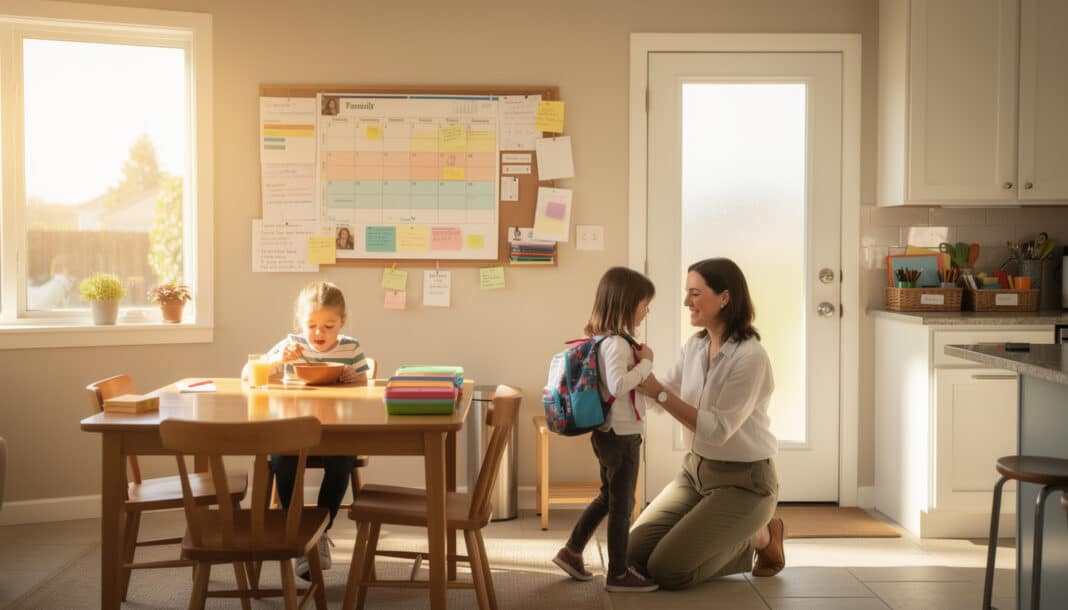
In short — Family mornings don't have to be a daily source of tension. A few concrete adjustments — preparing the night before, ritualizing the steps, gradually giving children responsibility — turn chaotic wake-ups into smooth, calm moments. The key lies in simplicity: a stable routine, visual tools, and accepting that perfection doesn't exist. Dozens of families report that these practices, implemented over three weeks, create a lasting morning organization without shouting or stress.
Why mornings turn into battlegrounds before school
Every parent knows this feeling: the alarm goes off, and suddenly the house flips into emergency mode. Between everyone's different biological rhythms, the pressure of tight timing and the accumulation of small decisions, the morning becomes a real obstacle course. It's not that children are “difficult” in the morning — it's the structure that pushes them there.
The absence of clear landmarks generates a colossal mental load. Who takes care of breakfast? Where are the spare shoes? Is the school bag ready? These cascading questions, asked repeatedly, exhaust both parent and child before they even leave the house. And when tension rises, oppositional behaviors naturally follow — resistance to getting dressed, whining, refusal to eat.
Learning how to manage mothers' mental load in seven steps offers a useful perspective to overcome this daily exhaustion.
The real secrets of families who succeed
Families whose mornings flow without crises share a common conviction: to anticipate is to reign. They don't discover in the morning that the outfit is dirty or the snack was forgotten. They have adopted a logic of anticipatory action that completely transforms the wake-up dynamic.
Prepare the night before: the 90% rule
Ninety percent of morning frictions stem from something forgotten the night before. An unzipped school bag, an outfit not chosen, breakfast not prepared: every decision postponed to the morning becomes a point of tension. Successful families establish an evening ritual, unchanging, that takes barely ten minutes but saves thirty minutes of stress the next day.
This commitment at dusk includes: laying clothes on a chair, placing the school bag near the door, preparing bowls and spoons, taking out the milk and cereal. The child, involved in this preparation, remembers it better and feels like an actor in the process, not a passive spectator.
Create a visual routine: from verbal to tangible
Telling a five-year-old “you must get up, wash, get dressed, eat and take your bag” is like giving a mental list to someone who doesn't yet have a stable cognitive organization system. By contrast, a poster with images — a child stretching, another washing their hands, an outfit, a bowl — speaks the language they understand.
This visual routine subtly transforms the relationship to authority. The parent shifts from the role of commander who orders to that of facilitator who accompanies. The child follows not because they are told to, but because it's “written” on their board. Resistance decreases mechanically.

Wake the child fifteen minutes earlier: create some buffer
The main cause of morning stress? A lack of real time. Children don't operate at the speed of stressed adults, and that's normal: it's a question of neurological development, not laziness. Waking the child a quarter of an hour before the strict necessity creates a buffer that absorbs the unforeseen — a stubborn shoelace, spilled milk, a last-minute clothing decision.
Those freed fifteen minutes also allow space for connection: a hug, a short pressure-free conversation. This morning affective contact reduces oppositional behaviors and creates a positive tone for the whole day.
Practical tools that really transform organization
Theory and practice only work together if the tools are within reach. Here are the ones that really work, tested by dozens of families since the start of the 2025-2026 school year.
The visible timer: externalize the pressure
“Hurry up!” repeated ten times in the morning doesn't speed a child up — it just creates generalized anxiety. A five-minute hourglass or a visible kitchen timer externalizes the pressure: it's time that is passing, not the parent who is shouting. For competitive children, timing “personal records” turns the routine into an engaging game.
The school bag checklist: empower without smothering
A magnetic board or a sheet hung at eye level lists what must go: homework, signed planner, PE kit, snack, water bottle. Each child ticks off items as they go. From kindergarten, with a parent's help, it's possible. For teens, it becomes a key element of autonomy.
Consulting the 2026-2027 school calendar to anticipate vacation dates also makes it possible to plan for “exceptional” mornings when the rhythm changes.
The morning playlist: set the rhythm without tyrannizing
Twelve minutes of gentle or upbeat music, depending on the family's taste, create an auditory landmark for the whole house. When the playlist stops, it's time to leave. No more ticking watch, no more pressing voice — just a kind sonic structure that children quickly internalize.
When each child has their own rhythm
Families with children of different ages face an additional challenge: the three-year-old doesn't wake at the same pace as the twelve-year-old. Forcing one to match the other's rhythm creates frustration and tension.
Ritualize without uniformizing
The trick is to stabilize the frame while allowing each person their own timing. Toddlers follow the illustrated routine with a parent who helps. School-aged children progressively become autonomous. Teens set their own alarms and manage their organization, made responsible by default.
Offering real margins of choice — which shirt to wear, which fruit to prefer at breakfast, in what order to do tasks — reduces opposition while maintaining the non-negotiable frame: hygiene, getting dressed, breakfast, school bag.
Parents on shifting schedules: time for connection saves everything
When one parent leaves early or comes home late, mornings can become silent passages, devoid of connection. Yet five minutes of intentional conversation just before leaving — even if the timing differs — restore this connection and temper the general agitation. It's less about quantity than the quality of presence.
What to systematically avoid
Some classic traps sabotage the best intentions. Knowing them is often enough to outsmart them.
Screens in the morning: the worst saboteurs
A tablet or a television first thing in the morning turns a child's brain into “intense stimulation” mode — the exact opposite of calm cooperation. Used as a final reward, screens become a powerful motivator: “once you're ready, you can watch your show.” Never before.
Negotiating on fundamentals
Some battles must be won once and for all: brushing teeth, getting dressed, leaving on time. Giving in once opens the door to repeated tests the next day. Parental consistency, without guilt, creates clear landmarks that the child ends up taking in as “that's how it is.”
Doing things for the children
Getting a three-year-old dressed, fine. But doing it at six, then at ten, blocks the acquisition of autonomy. The more the child masters their preparation — even clumsily — the deeper the ritual embeds. False starts, mismatched socks, messy hair are better than prolonged parental dependence.
Recognize and celebrate progress: the fuel for change
A child who has completed a smooth routine without being reminded deserves explicit recognition. Not a systematic material reward, but a sincere, warm “you got dressed all by yourself before the timer, I noticed!”
A morning star chart — one star per successful morning — with a small reward after a week without friction permanently transforms habits in children aged four to eight. This visible success mechanism creates a virtuous circle where the child recognizes themselves as an actor in their organization.
It typically takes about three weeks for a habit to really settle into a child's nervous system. Be consistent, gentle, patient — and above all, live the routine you ask of them. Children imitate what they see much more than they listen to what they are told.
Beyond the morning: a broader question of education
Transforming mornings without stress is about cultivating positive discipline: not one of control and punishment, but of progressively acquired autonomy and kind boundaries. This fits into a broader vision of what one wishes to pass on.
For those who wish to deepen questions of family organization more broadly, exploring how to build an optimal domestic environment can complement this reflection on the material framework conducive to well-being.
These morning rituals — simple, repeatable, kind — gradually become invisible threads that connect the family to itself. Not through perfection, but through the ability to move forward together, each at their own pace, within a stable and loving framework. That is where the real secret of mornings without shouting lies.
Profil de l'auteur
Derniers articles
 Smartphones & Mobile Phones14 October 2026The loyalty penalty on your mobile bill: why staying put costs you more
- Family, Babies & Children5 October 2026Airline family seating fees: what the planned ban will change for parents
- Everyday Life & Society23 September 2026Consumer confidence index: what the monthly mood check on British households really measures
- Agency, Webmarketing & SEO31 August 2026SEO : a Google bug skews visibility statistics in AI results




Table of Contents