The summer sales 2026 in France start on Wednesday, June 24 at 8 a.m. and end on Tuesday, July 21. This four-week period allows consumers to take advantage of regulated discounts across the entire territory, with a few regional exceptions such as Corsica which begins two weeks later. To optimize your purchases, it is essential to know the exact calendar, the price transparency rules and effective strategies to find the best markdowns without giving in to haste.
📌 Key takeaways: The summer sales 2026 begin on June 24 at 8 a.m. and last four weeks. 🏬 Corsica starts its sales on July 8. 💰 Mandatory display of the original price in-store and online. 📱 Progressive markdowns generally occur weekly. 🛍️ Check stock before traveling. 🌿 Favor Made in France to highlight local craftsmanship. 👀 The first days offer the best selection, the end of the period offers the largest discounts.
🗓️ The official calendar of the summer sales 2026 in metropolitan France
The government sets the dates of the sales each year to ensure fair competition and protect consumers against misleading commercial practices. For summer 2026, the opening is scheduled for Wednesday, June 24 at 8 a.m., a standardized time that applies to all retailers, whether physical or online. This synchronization allows brands to launch their marketing campaigns in a coordinated way and customers to organize themselves effectively.
The period ends on Tuesday, July 21, 2026, offering a total duration of four weeks. Contrary to some misconceptions, this duration is fixed and regulated by law, which avoids the endless proliferation of poorly defined promotions. Between these two dates, you will have a clear framework to plan your purchases, whether you are passionate about fashion, cosmetics or home décor.
The majority of metropolitan departments, including les Alpes-Maritimes et les Pyrénées-Orientales, follow this unified calendar. This uniformity makes life easier for multichannel retailers and customers who travel between regions. You can therefore note these dates with confidence for most of the territory.
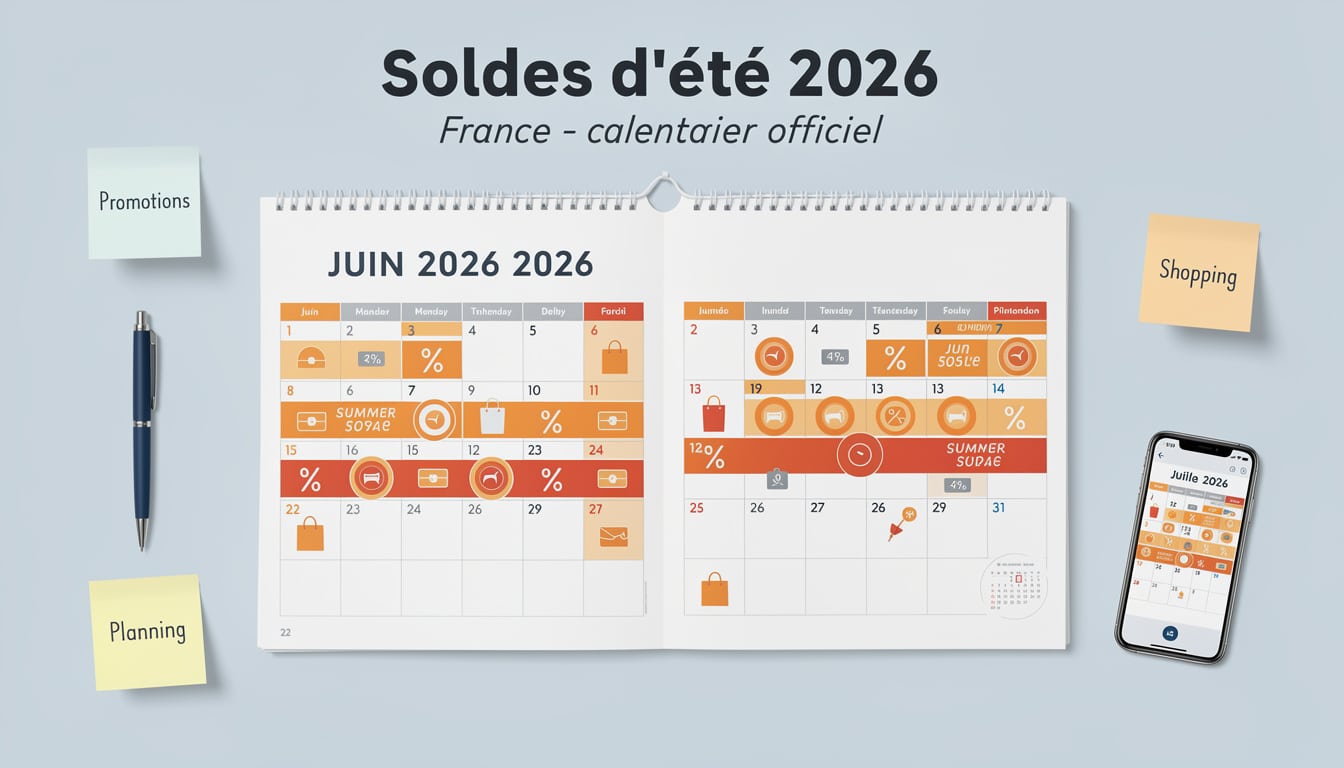
Regional variations: focus on Corsica and overseas territories
Corsica benefits from a shifted schedule for the summer sales, starting on Wednesday, July 8 and ending on Tuesday, August 4, 2026. This two-week shift responds to the particularities of island tourism and the local commercial rhythm, where the summer tourist influx follows a different curve than the mainland. For Corsican retailers, this window allows aligning discounts with periods of high footfall.
In overseas territories, calendars adapt to climatic and commercial realities. La Réunion holds its summer sales from February 7 to March 6, 2026, right in the middle of the austral summer. Guadeloupe and Martinique choose autumn: September 26 to October 24 for Guadeloupe, and October 1 to October 28 for Martinique. Saint-Pierre-et-Miquelon, Saint-Barthélemy and Saint-Martin have their own schedules, respectively from July 15 to August 11, and from October 10 to November 6.
These shifts are not arbitrary: they aim to maximize the effectiveness of promotions by aligning them with actual consumption periods. Consult the detailed dates of sales by region to know your local calendar precisely.
💡 Understanding the rules that govern the summer sales
Transparency is at the heart of the legal framework for sales. Every displayed price must mention the original price and the sale price, allowing the customer to quickly verify the percentage discount. This obligation applies equally in-store and online, on paper labels as well as on e-commerce web pages.
The Direction générale de la concurrence, de la consommation et de la répression des fraudes (DGCCRF) regularly monitors compliance with these rules. It carries out checks to detect inflated prices before the reduction, a prohibited practice that would consist of showing a false “normal price” before “reducing” it. These actions protect your interest as a consumer and maintain trust during promotional periods.
For retailers, this implies documented traceability: keeping invoices, previously displayed prices, and justification of discounts. For you, it means you can report any abuse to the DGCCRF if you detect a misleading practice.
Four weeks: a regulated and unchanging duration
Why exactly four weeks? This duration was set by decree in 2019 to replace the previous five weeks, reducing the “fatal” discount period while keeping a sufficient window. This 28-day duration is precisely delimited, from Wednesday June 24 at 8 a.m. to Tuesday July 21 inclusive for summer 2026.
A retailer cannot arbitrarily extend the sales or start them earlier, except in exceptional circumstances validated by ministerial order (as occurred during the Covid crisis in 2021). This regulation avoids a “sales war” where everyone would try to attract customers by starting before others.
🎯 Smart strategy to maximize your savings during the summer sales
To make the most of the summer sales 2026, careful preparation is essential. Two weeks before June 24, make a precise list of the items you are looking for: specific models, sizes, brands. This list becomes your compass during the four weeks and protects you from impulse purchases that seem appealing but do not actually match your needs.
Check the websites of the retailers you target to understand their progressive markdown policies. Although not regulated, markdowns generally follow a predictable schedule: first markdown on June 24 at opening, second around June 30 or July 1, third around July 7-8, and final markdown on July 14-15. Knowing this rhythm allows you to choose whether you prefer better selection early in the period or larger discounts later.
The first days: the art of choosing variety
The first three days of the summer sales, from June 24 to 26, concentrate the widest choice of items. Stocks are complete, all sizes available, and the most in-demand pieces have not yet disappeared from the shelves. If your priority is finding specific items rather than maximizing discounts, being present at the opening at 8 a.m. significantly increases your chances.
For e-retailers, check online availability before traveling to a store. Many brands offer online reservation with in-store pickup, saving you an unnecessary trip. This “omnichannel” approach (online + offline) has become the norm and you should take advantage of it.
The end of the period: when prices really drop
As the last week of the sales approaches, from July 14 to 21, discounts increase significantly. Items that did not sell during the earlier markdowns receive more aggressive reductions to quickly clear stock. You will find discounts of 50 to 70% on certain items, even more on remaining pieces.
The downside: choice becomes limited. Popular sizes and colors have disappeared, and only items in very small or large sizes or less desired colors remain. Adapt your strategy according to your priorities: maximum choice at the start, minimum price at the end, or a middle-ground balance.
🌍 Extended calendar: the sales in overseas collectivities
French overseas territories deal with climatic and commercial realities very different from the mainland. The Antilles-Guyana follow a radically different calendar, where the summer sales take place in autumn or early local winter, a period when consumption restarts after the tourist season.
In Guadeloupe, the summer sales begin the last Saturday of September and end the last Saturday of October. In Martinique, they start the first Thursday of October and last four weeks. Guyana follows a calendar similar to Martinique. Consult a detailed guide of dates by department to specify your location.
La Réunion, bathed in the austral summer, organizes its summer sales in February-March, an optimal window after the end-of-year holidays and before the austral rainy season. Saint-Pierre-et-Miquelon benefits from a schedule aligned with its short boreal summer, from July 15 to August 11, while Saint-Barthélemy and Saint-Martin extend the period from October 10 to November 6 to capture post-summer tourist flows.
The DOM-TOM in detail: adapt your purchases to the local calendar
For residents of overseas collectivities, understanding these calendar shifts is crucial for effective budget planning. La Réunion's sales in February-March allow renewing a light wardrobe before the austral winter, while those in the Antilles in autumn coincide with children returning to school and the start of a new commercial season.
A Réunion retailer, for example, adjusts their stock and marketing campaigns not according to the metropolitan calendar of June-July, but according to local reality. This creates a form of positive desynchronization: when Parisians enjoy the summer sales, Réunion residents prepare their spring purchases, and vice versa.
📱 Online sales: the same rules as physical stores
French e-commerce sites must strictly respect the same dates as physical stores. Wednesday June 24 at 8 a.m. for the opening, Tuesday July 21 for the closing, without exception. An online retailer cannot start its sales earlier to steal a few customers from its direct competitors.
Price transparency also applies online with the same rigor as in stores: display of the original price, the reduced price, and the percentage discount. Return and exchange conditions remain subject to general regulations, and the legal withdrawal periods (14 days) apply in full.
For buyers, this means comparing offers online and in-store gives a fair picture. An item will never be on sale on an e-commerce site a few days before the official start in stores: synchronization is mandatory and controlled.
Buying online during the sales: advantages and cautions
E-commerce offers valuable tools during the sales: price filters, comparators, restock alerts, the ability to check stock before clicking. You can browse at your own pace, without the pressure of crowds, and often benefit from reduced or free shipping during this period.
However, beware: check delivery times. During the summer sales, lead times can lengthen by a few days due to limited logistic capacities. If you order on July 20, the last days of the sales, your parcel may arrive after the official closing, with no possibility of exchange during the promotional period if the product does not suit you.
✨ Advanced strategies to find the best markdowns
Beyond simply checking the dates, a true buyer's strategy involves understanding the psychology of markdowns. The best deals are never found on the first day: on that day, margins remain substantial. Reductions intensify gradually to turn stubborn stock into liquidity.
Create a ranking of your priority items: the “must haves” where you accept 20-30% off, the “wishes” where you aim for 40-50%, and the “bonuses” where you don't mind 60-70% or more. This hierarchy helps you decide when to buy: a “must have” found on June 26 at 30% off is often better than a “bonus” found on July 20 at 60%, because the former corresponds to a real need.
Also explore second-hand brands or clearance stock at the start of the period. Some retailers offer items from previous seasons alongside new collections: a summer dress from 2025 on sale in 2026 can offer excellent value for money if you like the style.
Showcasing French know-how during the sales
The summer sales are a remarkable opportunity to discover French brands and local artisans at reduced prices. Made in France often shines in quality and durability, and discounts make it temporarily more accessible.
Brands of underwear like Le Slip Français, fashion brands like Sezane or Maison Kitsuné, beauty brands like Nuxe, or home decor brands regularly offer sales. Buying local during this period supports the French economy while benefiting from an improved quality-price ratio. A Made in France product on sale often represents a better deal than a cheap imported product.
To identify French producers, look for the mentions “fabriqué en France” or “conçu et fabriqué en France” when shopping. Many small brands proudly announce their local origin, especially in cosmetics and accessories.
🛒 Pre-sale preparation: the real key to success
The week before June 24, focus on preparation rather than impatience. Browse the sites of your favorite brands, spot items in stock, check available sizes, read customer reviews to confirm your choice.
Set a realistic budget. Sales are seductive but do not create magic money: setting a maximum envelope prevents impulse spending. A good tip: check your account statements and consumption habits over the last three months to calibrate a budget consistent with your lifestyle.
Check the markdown calendars of the retailers you target. Some big stores display their forecasts for additional reductions; anticipating their rhythms allows you to wait on an item expected to be further reduced, or to rush on a volatile piece likely to disappear.
Digital tools to track the best offers
Mobile apps and browser extensions greatly simplify tracking the sales. CamelCamelCamel (for Amazon), Keepa, or the alerts built into many e-commerce sites notify you when an item goes on sale or experiences a new markdown.
Brands' social networks also broadcast exclusive announcements: extra discount codes, private sales before the official start, or lightning flash-sales on specific items. Following the Instagram, Twitter or newsletters of your favorite brands increases your chances of snapping up the best opportunities before stock runs out.
📊 Markdowns explained: when prices really drop
Markdowns are additional reductions applied progressively during the sales period. Contrary to what some think, these are not law-defined magical moments: each retailer sets its own schedules.
However, a near-universal practice has emerged: the first markdown on the opening day (June 24), then additional markdowns roughly each week. An item sold at -30% on June 24 can move to -50% on July 1, then to -70% on July 15. This progression follows a simple logic: selling quickly costs less than storing.
Visiting a store or site once a week during the sales lets you observe this progression and adjust your strategy. An item that tempted you at -30% but that you deliberately ignored may reappear at -50% a week later, justifying your patience.
Interpreting price tags to verify real discounts
One dishonest practice persists: inflating the “normal” price before reducing it. The tag may display “normal price €100, reduced price €70”, but the real normal price was €75. Checking previous prices helps detect this deception.
If an item interests you, note its price a week before the sales and compare it with the “original price” announced during the sales. Apps like Keepa track Amazon prices, offering objective traceability. For physical stores, asking the salesperson if the displayed price was really the one applied before the sales is legitimate.
The DGCCRF sanctions this practice: a report can be filed if you detect a suspicious discrepancy. Your vigilance protects other consumers and helps maintain market integrity.
🎁 Private sales: the preview of the summer sales
About one or two weeks before June 24, some retailers organize private sales or “previews”. Unlike official sales, private sales are not legally regulated and remain at the retailers' discretion. They generally target a loyal clientele (loyalty program members, newsletter subscribers).
Discounts in private sales are usually less generous than in the official sales: 20 to 40% rather than 50 to 70%. However, the advantage is the intact selection and the possibility of shopping with less crowding, making the experience more serene. Items offered in private sales may then (or may not) be included in the official sales.
If you are a brand loyalist, checking their private sale announcements in mid-June offers an early access window. You may not ultimately pay less, but you will benefit from a better selection at a time when the attendance remains controlled.
🌟 Final tip: balance appeal and coherence
The summer sales seduce with the opportunity to save, but the best purchase is still the one that fits your real lifestyle. An item on sale that you will never wear remains an expense, not a saving.
Before each purchase, ask yourself the simple question: “Would I have bought this at full price?” If the answer is no, the discount does not invalidate the lack of real need. Conversely, a useful item found at a reduced price after weeks of searching represents a true victory for the savvy buyer.
Check out a complete calendar of the 2026 sales in France to orient yourself geographically and temporally. Mark June 24 at 8 a.m. in your calendar now, prepare your list two weeks before, and approach these four weeks with strategy rather than haste. Happy finds for summer 2026! 🌞
Profil de l'auteur
Derniers articles
 Electricity, Gas & Energy14 September 2026Gaz et électricité : ce que la hausse des tarifs va changer sur votre facture
- Agency, Webmarketing & SEO12 September 2026Fusion Omnicom-IPG : ce que la plus grande agence de publicité au monde change pour les marques
- Retirement & Senior Living10 September 2026Carte Avantage Senior SNCF : comment voyager moins cher en train après 60 ans
- Tech & Multimedia8 September 2026Objets connectés : la fin de la 2G et le nouveau Data Act vont rebattre les cartes




Table of Contents