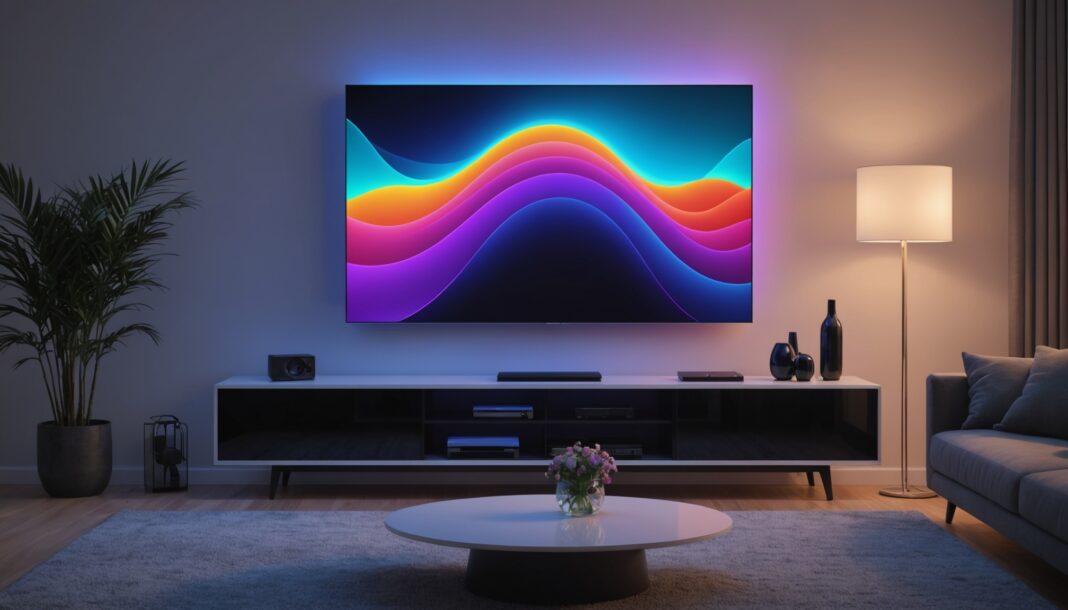
A new generation of TVs is about to shake up the high-tech shelves: Micro RGB, a backlight technology introduced by Samsung as a direct alternative to OLED. Behind this somewhat technical name lies a simple promise: more accurate colors and higher brightness, without sacrificing contrast. In concrete terms, what does this change for anyone considering buying a new TV?
What Is Micro RGB Technology?
The concept relies on microscopic red, green, and blue LEDs, each measuring less than 100 microns, used directly as the backlight unit. Unlike conventional panels that filter white light to produce colors, each Micro RGB sub-pixel generates its own color without conversion or light loss. The announced result: 100% coverage of the BT.2020 color space, the reference standard for ultra-high-definition broadcasting, combined with peak brightness levels well above those of a standard Mini LED panel.
Samsung introduced its Micro RGB lineup in several sizes, from 55 to 115 inches, with a high-end model that also includes an anti-glare treatment to reduce glare in bright rooms.
Micro RGB vs. OLED and QLED
The comparison with OLED is inevitable, since that's precisely the ground on which Samsung is positioning this new technology.
- OLED remains the benchmark for deep blacks and contrast, thanks to its self-emitting pixels that switch off individually.
- QLED/Mini LED relies on larger LEDs combined with quantum dots, offering already high brightness but less precise local contrast.
- Micro RGB sits between the two: contrast close to that of OLED, but with superior brightness and ambient-light resistance, at the cost of a slightly less deep black in total darkness.
In other words, no technology comes out on top across the board: the right choice mainly depends on the use case—a very bright living room, a home theater in the dark, or mixed use.
What This Means When Buying
This new label adds to an already long list of marketing acronyms (QLED, Neo QLED, Mini LED, OLED, QD-OLED…), which complicates comparisons in stores. Before being swayed by a flashy technology name, it's still worth checking a device's actual specifications—a habit that's also useful for understanding the technical differences between two categories of hardware before making a decision.
Another point worth watching: the lifespan and repairability of these new TVs. The issue is all the more sensitive since the consumer electronics industry is undergoing a broader reckoning with planned obsolescence, as recently illustrated by the debate over the end of France's repairability index for smartphones. A high-end TV represents an investment spanning several years: the availability of spare parts and the manufacturer's warranty policy deserve as much scrutiny as the spec sheet.
Finally, for the most recent models or limited editions, some buyers turn to platforms specializing in limited-edition high-tech products rather than traditional big-box retailers—an option worth considering if a Micro RGB model is slow to arrive at regular retailers.
Frequently Asked Questions
Will Micro RGB replace OLED?
No, the two technologies are expected to coexist. OLED retains the advantage in total darkness, while Micro RGB is aimed more at bright rooms and uses that demand high brightness.
Are Micro RGB TVs already available in France?
Samsung introduced its 2026 lineup in several sizes, from 55 to 115 inches, with a gradual rollout among retailers. Prices and exact availability vary by retailer.
Do you need to replace your TV to enjoy this technology?
There's no rush: a recent Mini LED or OLED TV remains largely satisfying. Micro RGB is aimed mainly at those upgrading their equipment and looking for the best brightness-to-contrast balance on the market.
Sources
- Samsung France — official presentation of 2026 Micro RGB TVs
- L'Éclaireur Fnac — Samsung Micro RGB 2026, the new benchmark in the TV market
- Abt — Micro RGB vs. OLED comparison
Profil de l'auteur
Derniers articles
 DIY & Troubleshooting28 November 2026Paying for Your Tools in 3 or 4 Installments: The New Rules You Need to Know
- Ecology & Environment28 November 2026Eco-Tax on Ultra-Fast Fashion: What the New Law Changes
- Smartphones & Mobile Phones28 November 2026Vitale Health Card on Smartphones Becomes a FranceConnect Key to Public Services
- Referrals & Promo Codes28 November 2026Bank Referral Bonuses: Offers Ending December 31 — How to Not Miss Out




Trending now on legal streaming
FilmHeart of the Beast
SeriesLupin
This article was written with the help of artificial intelligence. Editorial policy
Table of Contents