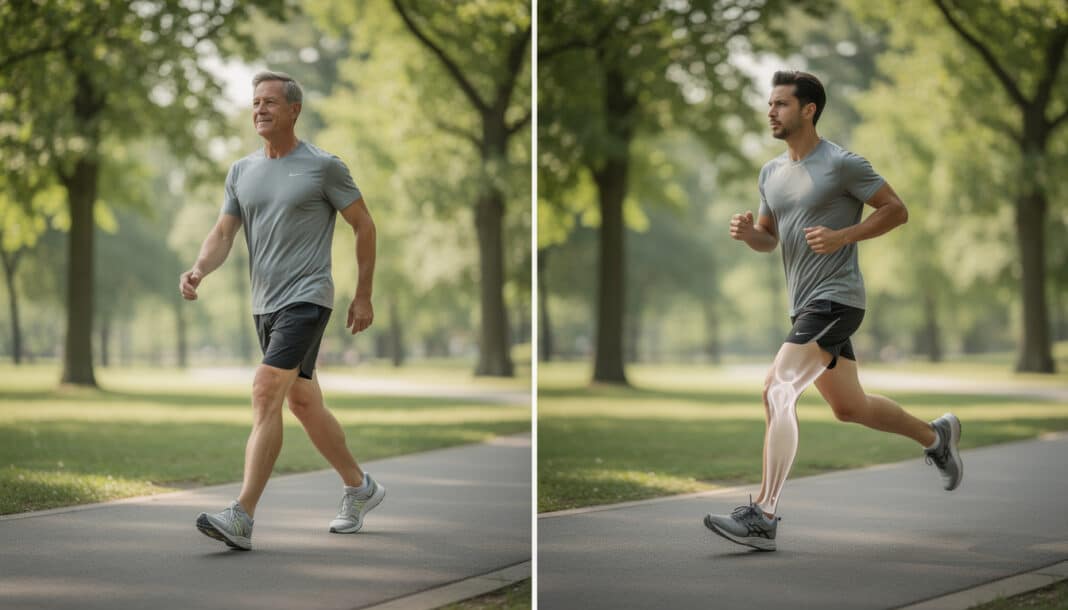
📌 In short — Walking or running? A choice that shouldn't be improvised, especially when it comes to protecting your joints. Where running generates impacts three times your body weight, brisk walking offers a subtle balance: enough intensity to transform the heart, gentle enough to spare knees, ankles and the spine. Between these two worlds, there is a middle ground that too many people ignore.
During about thirty minutes of moderate running, your body burns roughly 453 calories — versus 261 when walking. But this purely arithmetic calculation hides a more nuanced truth: it also depends on your age, your medical history, and above all your ability to sustain it over time. Durability is precisely what sensible people are after. The real question is therefore not “which activity burns the most?”, but rather “which activity can I do without destroying my body?”.
🦵 Understanding the basics: walking, running and the forces at play
To grasp the stakes, let's start with a simple biomechanical distinction. When you walk, at least one foot is always in contact with the ground. When running, you take flight — even if just for an instant. This tiny physiological detail produces major consequences for your joints.
This difference generates radically different ground reaction forces. Running produces shocks equivalent to 2.5 times your body weight at each impact, while walking is limited to 1.2 times. Imagine it like a bookbinder at work: some gestures require delicate, repeated pressure (walking), others demand sharp, decisive blows (running). Both shape the work, but with different wear patterns.
Brisk walking sits between these two universes — neither as intense as running, nor as passive as a Sunday stroll. At this pace, the heart and muscles are more engaged while preserving the comfort of knees and ligaments. It's precisely this balance that those who want physical activity to remain sustainable are looking for.

💪 Distinct benefits: beyond the simple calorie calculation
Of course, running increases your VO2 max more — that key indicator of your aerobic capacity. A regular runner improves cardiovascular endurance faster than a walker. But that advantage has a flip side: more intensity also means more joint fatigue and an increased risk of stress fractures.
Walking, on the other hand, offers surprises. Studies show it stimulates creativity — while running simply uplifts the mood. It reduces stress in a gentler, more meditative way. Remarkably: a Taiwanese study found that five minutes of running equaled fifteen minutes of walking in terms of overall longevity. The equation is therefore never simple.
According to some specialized sources, real wisdom is to combine the two: use running to improve cardiovascular fitness, and walking to recover while staying active. Ultrarunners have long understood this — alternating intensity and active rest is the key to holding up over time without collapsing.
🎯 Joint protection: the heart of the matter
Here is the major issue that justifies this entire article. Joint health is not a medical abstraction — it is your freedom of movement in ten, twenty, thirty years. When running subjects your knee to repeated shocks, it does build denser bone. But it also risks creating cumulative microtraumas.
This paradox explains why doctors recommend brisk walking to people with mild osteoarthritis or fragile joints. Brisk walking limits jolting impacts, preserves the spine, strengthens tendons and ligaments without attacking them. It's meticulous work, without noise — like a binding: solid but elegant.
For those facing a choice of activity after a past injury, the solution becomes obvious. Replacing a running session with a brisk walk allows you to maintain fitness while giving your joints the rest they need. And when even that approach seems too intense, swimming or cycling become natural allies — low-impact activities where the water or the bike absorb the shocks for you.
⏱️ Intensity versus endurance: rethinking the wellness equation
One of the fascinating paradoxes: to burn as many calories walking as running, you have to walk longer — of course. But this “constraint” hides an opportunity. Have you noticed how long walks favor reflection? How runners admit that real suffering begins beyond thirty minutes? Physical activity is not just a calorie burner.
Brisk walking offers a different rhythm. You sustain effort for 30 to 45 minutes, at about 5 km/h — a pace that's accessible but stimulating. Your heart speeds up without putting you in distress, your muscles work without crying for help. It's a natural injury prevention by wisdom rather than restriction.
And then there's this often forgotten marvel: Nordic walking. You walk fast, but armed with poles. This simple accessory transforms the equation by also engaging the upper body — your shoulders, back and arms become active. Endurance is multiplied as a result.
🏃♀️ When to choose running, when to prefer walking?
Let's be concrete. If you're thirty, have no joint history, and dream of transforming your silhouette in three months, running is still your best investment. It burns 30% more calories over the same distance, slims faster, and strengthens muscle tone more quickly.
Conversely, if you're over fifty, if your knees remind you of their existence at the slightest climb, or if you have a more holistic vision of well-being — brisk walking becomes your secret weapon. Studies show that regular walking and slow running produce comparable results in terms of longevity — with far less damage.
And then there's that third path too many ignore: alternation. One week, three brisk walking sessions and one easy run. You work your endurance without wearing down your joint capital. That's how smart athletes stay active while others limp.
🔬 What science really reveals
The data exists, quantified and measurable. A person weighing 72.5 kg burns 15.1 calories per minute running, 8.7 when walking. Over thirty minutes, that creates a gap of 192 calories. Arithmetically clear — but humanly? Can you really sustain thirty minutes of intense running every day, every week, every month, for years?
Longitudinal studies suggest it: light jogging practiced two or three times a week reduces the risk of death by 25%. But daily intensive training does not offer more longevity benefits. A few regular minutes of brisk walking, combined with true vigorous activity occasionally — that's the real secret of those who age well.
According to detailed analyses of the choice between running and brisk walking, the decisive criterion remains long-term joint impact. Because a stress injury, a chronic tendinitis, a damaged cartilage — that's what stops people. Not fatigue, not lack of motivation, but cumulative joint impact.
🧠 Mental health and well-being: beyond the body
Here lies a detail fitness apps royally ignore. Running and walking don't just sculpt your calves — they sculpt your mind. One exalts, releasing endorphins in waves. The other soothes, opening the mind to creative reverie.
Walkers report increased mental clarity after a long walk. Runners speak of euphoria, of transcendence. Both treat mild depression and anxiety, but differently. If you're more anxious, walking suits you better — it calms without extinguishing. If you fight a dull melancholy, running wakes you up.
And then there's the social factor. A Nordic walking group creates a real community — you walk together at a human pace, you can talk. A running group is different: it's a shared challenge, a communion through effort. Neither is superior, simply distinct.
🛠️ How to make the right choice for your personal situation
Forget dogmas. Your choice depends on four variables: your health history, your age, your concrete goals, and frankly — what you'd enjoy doing. Regular pleasure always beats occasional brilliant efficiency.
Do you suffer from lower back or neck pain? Brisk walking becomes mandatory. Do you need to lose weight quickly for an event? Running, accompanied by active recovery walking. Are you aiming to age actively without damage? Alternate — two brisk walks, one easy run, one bike ride.
Further adjustment naturally follows. Wearing the right running shoes makes more difference than you might think — optimal support absorbs impacts, truly protects. Consulting your doctor before restarting exercise is not a weakness, it's wisdom.
And if you discover along the way that you enjoy brisk walking more than running? Congratulate yourself. You've just found the activity you'll stick with — because the best physical activity is the one you do regularly, year after year.
Profil de l'auteur
Derniers articles
 Electricity, Gas & Energy14 September 2026Gaz et électricité : ce que la hausse des tarifs va changer sur votre facture
- Agency, Webmarketing & SEO12 September 2026Fusion Omnicom-IPG : ce que la plus grande agence de publicité au monde change pour les marques
- Retirement & Senior Living10 September 2026Carte Avantage Senior SNCF : comment voyager moins cher en train après 60 ans
- Tech & Multimedia8 September 2026Objets connectés : la fin de la 2G et le nouveau Data Act vont rebattre les cartes




Table of Contents