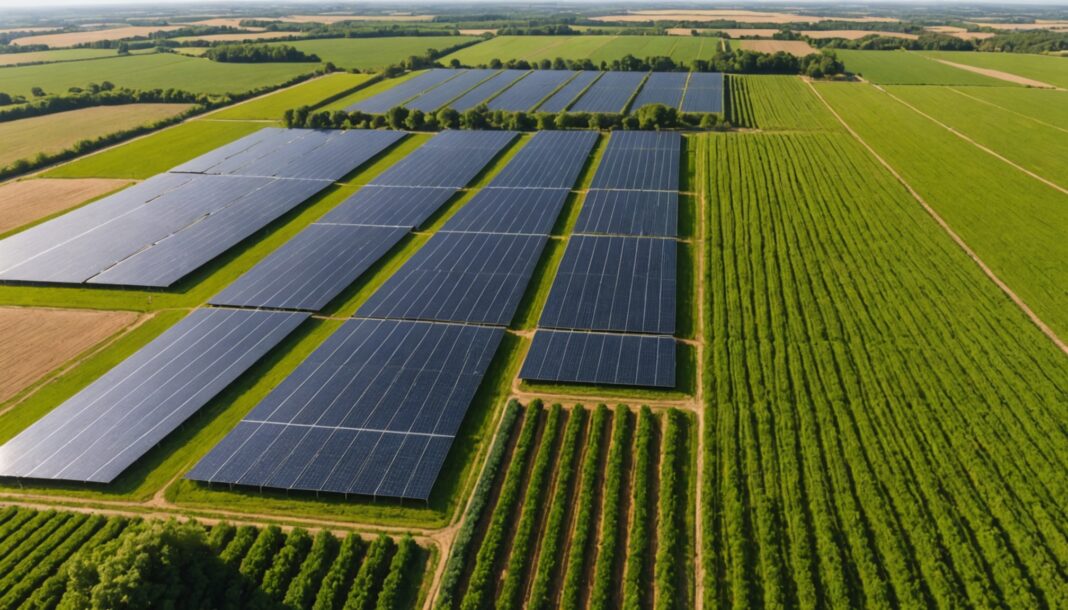
Long confined to pilot projects, agrivoltaics is changing scale in France. Between a now-stabilized legal framework and a sector that is structuring itself, more and more farm operators are asking themselves: should they install solar panels above their crops or pastures? Behind the trend, the reality is more nuanced. Here is what is changing concretely for farmers, without excessive promises.
A legal framework finally clarified
The loi APER of 10 March 2023 laid the foundations, then the decree of 8 April 2024, supplemented by the order of 5 July 2024, set the rules of the game. In March 2026, the Conseil d'État confirmed the legality of the main provisions of this decree, lifting much of the uncertainty that weighed on projects. The principle is clear: the photovoltaic installation must remain in service of agricultural production, not the other way around.
Concretely, the text imposes several safeguards. Ground coverage by panels is capped at 40% for cultivated plots. Yield loss must not exceed 10% compared with a control plot left without installation. And each project must bring a tangible agronomic benefit: protection against hail or heatwaves, water savings, better animal comfort or maintenance of biodiversity.
A sector that is accelerating
The movement is no longer marginal. The capacity of the French agrivoltaic park almost doubled between 2021 and 2025, and more than 1,000 projects were recorded nationwide in 2025. To provide visibility, the State and ADEME have put in place a national observatory mapping installations in service or authorized. The stated objective of public authorities: to support the development of solar energy while avoiding the excesses of a mere race for land.
Supplementary income or a false good idea?
For many farm operators, the main attraction remains financial. According to an Ipsos survey, 56% of farmers see agrivoltaics as a potential source of additional income, and 49% believe it can protect their production against certain climatic hazards. In a context of thin margins and ever drier summers, partial shading from panels is appealing, notably in livestock and arboriculture.
But caution remains advisable. The return on investment is counted over the long term, and a poorly designed project can penalize yields or complicate the work of machinery. The points of vigilance are well known:
- Retain control of your land: clearly define the duration of the lease, responsibilities and the fate of the installations at the end of the contract.
- Verify real agronomic compatibility with your crops or herd, supported by figures.
- Anticipate the procedures: authorizations, opinions from the chamber of agriculture and grid connection take time.
A planning challenge for rural areas
Beyond individual farming operations, agrivoltaics reshuffles the balance between food production and the energy transition. Well regulated, it can consolidate an agricultural income without sterilizing land. Poorly controlled, it risks fueling tensions around land. This is precisely the intent of the thresholds set by the decree: to guarantee that the base remains primarily agricultural. The issue thus intersects with questions of energy and the future of the countryside, as shown by local debates around numerous projects in agriculture and livestock.
Frequently asked questions
What is the difference between agrivoltaics and ground-mounted panels?
A ground-mounted power plant occupies the land solely to produce electricity. Agrivoltaics, by contrast, must maintain significant agricultural activity beneath or between the panels: food production remains the primary use of the plot.
Can a farmer lose control of their land?
The framework aims to prevent this, but it all depends on the contract signed. It is essential to negotiate the duration, dismantling clauses and to seek support, notably from your chamber of agriculture, before any commitment.
Does the installation really reduce yields?
Regulations limit the loss to a maximum of 10% compared with a control plot. In some cases of extreme heat, shading can even reduce water stress and protect crops, but effects vary greatly depending on the production.
Sources
- Notre Environnement (Ministry of Ecological Transition) — regulatory framework for agrivoltaics
- La France Agricole — the agrivoltaics observatory is finally online (State / ADEME)
- Réussir Bovins Viande — a new framework for agrivoltaics
Profil de l'auteur
Derniers articles
 Psychology16 September 2026Santé mentale : pourquoi la France en fait une priorité nationale
- Moving & Transport16 September 2026Déménagement 2026 : les obligations légales à vérifier avant de signer
- Retirement & Senior Living14 September 2026Retraites : ce que le gouvernement prépare pour économiser sur votre pension
- Weddings & Special Occasions13 September 2026Mariage : pourquoi la date choisie peut faire varier la facture de plusieurs milliers d'euros




Table of Contents