


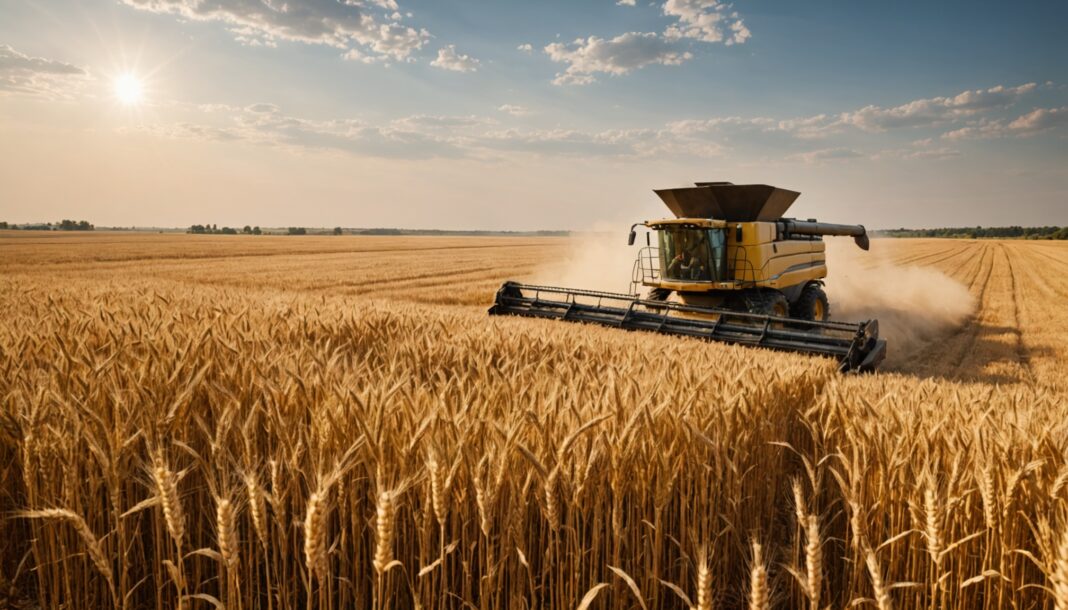
The 2026 harvest delivers its first lessons, and they are mixed. After a series of heatwave episodes, including one historically early in May, French farmers brought in soft wheat of good quality but in disappointing quantities. According to estimates from Agreste, the statistical service of the Ministry of Agriculture published on 15 July 2026, soft wheat production would be around 32 million tonnes, down 4% year-on-year.
An early harvest, forced by heat
A striking feature of this campaign: earliness. The high temperatures at the end of spring accelerated the ripening of cereal crops, bringing forward harvest operations by several days in many regions. This advance allowed field monitoring systems to compile thousands of farm reports very early.
But this earliness has a downside. Heat peaks that occurred during flowering, a key period for grain filling, weighed on yields. The most affected areas include Vendée, Poitou-Charentes, Grand Est and Bourgogne-Franche-Comté, where differences from one field to another can be considerable.
Soft wheat: quality saves a mixed campaign
The paradox of 2026 can be summed up in one sentence: the quality is there, the quantity is lacking. Initial checks at the silo report healthy grain, with criteria deemed reassuring, even as yields decline significantly. Confirmed figures at this stage:
- Soft wheat yield: 69.3 q/ha national average according to Agreste, about 5 q/ha less than in 2025 — the fourth campaign below the 70 q/ha mark since 2017.
- Soft wheat production: around 32 million tonnes, down 4% year-on-year, despite a slightly larger cultivated area (+2.8%).
- Durum wheat: around 51.7 q/ha, in a very heterogeneous regional context.
- Agronomic fallows: about 518,000 hectares, up 4.8% year-on-year.
In other words, the increase in sown areas was not enough to offset the decline in yields linked to the weather. A phenomenon that directly weighs on farm income, already under pressure due to rising costs.
When satellites and field data refine estimates
To compile these assessments faster and more finely, the sector increasingly relies on the data. Collaborative maps aggregate in real time yield reports from more than a thousand farmers, while satellite imagery makes it possible to estimate the potential of a wheat field even before the combine harvester passes. These tools do not replace official surveys, but they offer an early snapshot, useful to cooperatives as well as to markets. Readers curious about these innovations will find further analyses in our section Technology and Science.
What this harvest changes in practice
For the sector, a harvest of good quality remains commercially good news: wheat that meets solid criteria sells better, particularly for export and milling. But reduced volumes mean fewer tonnes to market, in a market where prices do not always compensate for the shortfall. For the general public, the effect on the price of bread or pasta remains indirect and delayed: the raw material represents only a fraction of the final price. Remains the fundamental question of adaptation to climate, which we follow in our pages Écologie et Environnement and Vie pratique et société.
Frequently asked questions
Why are wheat yields falling in 2026?
Mainly because of heat waves, including a very early one in May, that occurred during flowering and grain filling. The plant lacked time and water to form full ears, hence yields declined despite a slight increase in sown areas.
Is the quality of 2026 wheat good?
Initial checks at the silo are considered reassuring for soft wheat: the grains are healthy and the quality criteria are satisfactory. That is the positive point of a campaign otherwise marked by disappointing volumes.
Will this reduced harvest raise the price of bread?
Not mechanically. Wheat represents only a small part of the cost of a baguette, where energy, labor and distribution weigh most heavily. A decline in yields can tighten markets, but its effect on the final consumer price remains limited and delayed.
Sources
- La France Agricole — Soft wheat production expected at 32 Mt, down 4 %
- Terre-net — Agreste estimates for soft wheat yield 2026
- Réussir Grandes Cultures — Reassuring quality but lower yields
Profil de l'auteur
Derniers articles
 Electricity, Gas & Energy14 September 2026Gaz et électricité : ce que la hausse des tarifs va changer sur votre facture
- Agency, Webmarketing & SEO12 September 2026Fusion Omnicom-IPG : ce que la plus grande agence de publicité au monde change pour les marques
- Retirement & Senior Living10 September 2026Carte Avantage Senior SNCF : comment voyager moins cher en train après 60 ans
- Tech & Multimedia8 September 2026Objets connectés : la fin de la 2G et le nouveau Data Act vont rebattre les cartes




Table of Contents

 and 69.3 q/ha after the heatwave, but quality remains high. Analysis and key figures.)