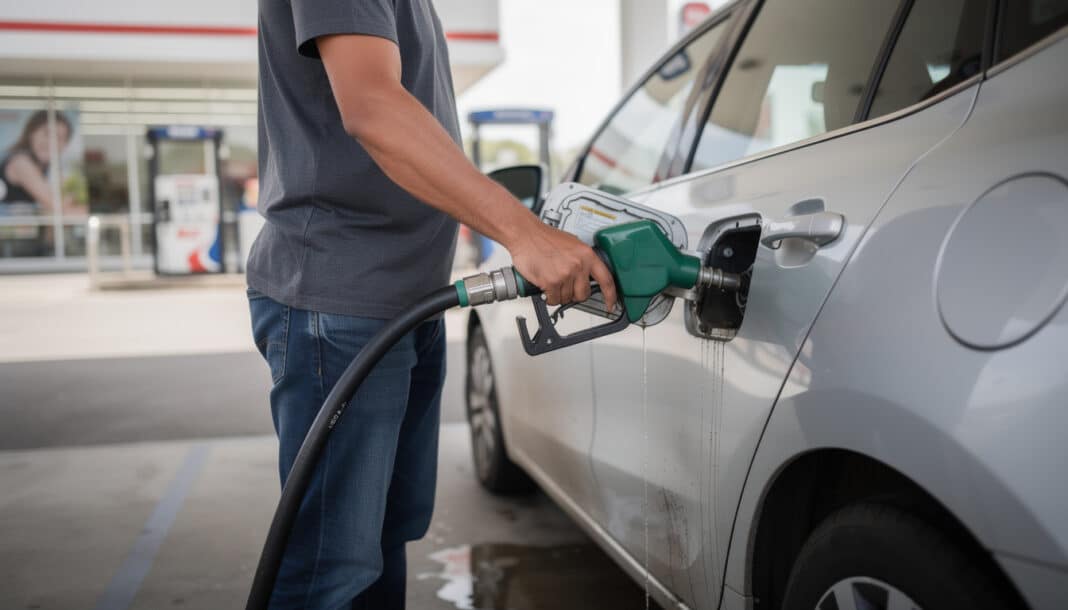
Each year, more than 100,000 motorists in France make a mistake at the pump without realizing its financial consequences. Between distraction, fatigue or confusion with a rental vehicle, mishandling the fuel nozzle literally costs the most distracted drivers a full tank. In 2026, with fuel price volatility, this common mistake weighs more heavily on household budgets.
In short: Getting the wrong fuel at the service station remains one of the most common mistakes in France, affecting more than 100,000 motorists annually. Petrol instead of diesel (or vice versa) leads to draining costs around 150 to 200 €, not to mention potential mechanical damage. Engines tolerate only 3 to 10% of wrong fuel before being damaged. Realizing this mistake directly at the pump remains the best outcome: a breakdown service will take you to a professional. If the engine has already run on the wrong fuel, the risks increase significantly and repairs can prove much more expensive.
How a mishandling at the pump creates invisible waste
Confusion between fuel types occurs more often than one might think. Although the nozzles carry distinct color codes — blue for diesel, green for SP95 or SP98 petrol — distraction remains drivers' number one enemy. Driving several different vehicles in the course of a week multiplies the risks: switching from a diesel sedan to a petrol city car, or vice versa, quickly muddles reflexes.
What makes this mistake particularly insidious is that it can go unnoticed for a few kilometers. Engines have a small mechanical tolerance allowing them to run on inadequate fuel, estimated between 3 and 10% maximum. Beyond that, damage becomes inevitable and costly.
Consider the case of Marie, a logistics manager, who alternates each week between the company's diesel company car and her small petrol Peugeot. One Monday morning, exhausted, she fills the tank of her personal car with diesel. She drives about 15 kilometers before feeling jerks from the engine. Too late: the wrong fuel is already doing its destructive work. Result: 180 € for an emergency drain and three days without a car.
Differences in severity according to the type of fuel mixed
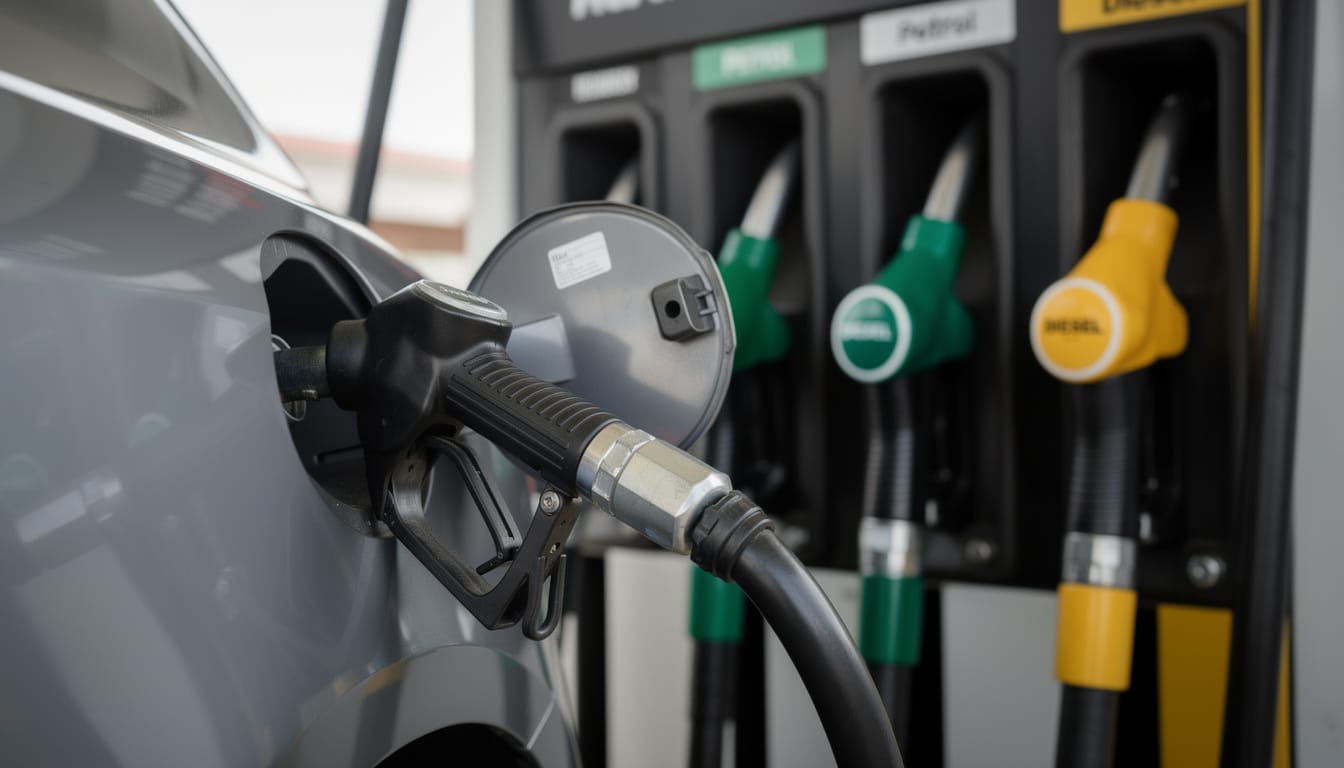
Not all fuel mistakes are equal. Putting petrol into a diesel engine represents a less critical situation than the reverse, because petrol has explosive properties, unlike diesel. When petrol reaches a diesel engine, it ignites prematurely in the combustion chambers, creating violent thermal shocks that damage the injectors, the high-pressure pump and the piston rings.
Conversely, pouring diesel into a petrol tank generally causes a progressive failure. The engine coughs, sputters, then stops. In this scenario, quick intervention limits the damage to a simple drain and replacement of the fuel filters.
Alternative fuels like the superethanol E85 or LPG further complicate the picture. A motorist equipped for E85 who uses standard SP95 risks starting problems and noticeable overconsumption, while the reverse damages the injection system specifically calibrated for that fuel.
The crucial question: did you discover the mistake in time?
Timing determines everything. If you spot the mistake directly at the service station, before even restarting the engine, call a breakdown service immediately. Do not start the vehicle — that's the key. The wrong fuel will not have reached the engine, and a simple tank drain with replacement of the filters will solve the problem for 150 to 200 €.
Unfortunately, most motorists only realize their mistake after having driven several kilometers. The first signs manifest as jerks on acceleration, abnormal loss of power or a clicking noise in the engine. At this stage, the wrong fuel has already circulated through the injectors and damaged mechanical components.
Inspection by a professional then becomes unavoidable. The mechanic must remove the rear seat to access the tank, completely drain the system, replace the soiled filters and, in severe cases, clean or replace the injectors. Count on an average of two hours of labor, not to mention additional parts to change depending on the identified damage.
When the mistake makes costs skyrocket
If the engine has run for a long time on the wrong fuel, repairs can far exceed 200 €. Damaged injectors cost 300 to 600 € each — an engine generally has four. The fuel pump, a critical component, can fail and require 400 to 800 € for replacement depending on the model.
In the worst-case scenarios, notably with petrol in a high-performance diesel, the engine itself suffers internal breakages. Cracked piston rings, damaged cylinder head, failing turbo… The bills then approach 2 000 to 5 000 €, or more depending on the age and complexity of the engine. At that price, some owners prefer to consider replacing the entire powertrain.
That's why prevention and vigilance at the pumps remain your best allies. Each year, this common mistake represents a considerable financial loss for French motorists, equivalent to the consumption of an extra tank without any benefit in return.
Concrete strategies to avoid this costly mistake
Developing simple habits drastically reduces the risk of making a mistake at the pump. Take three seconds to check the fuel type written on your fuel cap or in the filler door — almost all modern vehicles indicate it clearly. Additionally, a quick read of the owner's manual, particularly important when renting a vehicle, spares you unpleasant surprises.
Drivers accustomed to alternating between several cars should use a personal mnemonic technique. Some discreetly stick a colored sticker inside the fuel cap, others take a photo of the dashboard at the time of refuelling to confirm later. These small rituals, insignificant in appearance, literally save hundreds of euros per year.
Before leaving for a long trip or taking a new vehicle, ask the dealer or the rental company. A few clear pieces of information about the appropriate fuel take less than a minute and give you peace of mind. By consulting specialized resources on fuel availability, you also plan your route more calmly.
The importance of a quick check before starting
A few extra seconds at the pump can save you months of hassle. Before leaving the service station, check your dashboard: some vehicles display the detected fuel type. Also listen to the engine noise when starting — a difficult start or abnormal noises immediately signal an anomaly.
An unknown tip is to check the viscosity of the fuel through the filler cap window. Diesel has a thicker, slightly yellowish texture, while petrol is clear and colorless. This basic observation is enough to detect a mix-up before it becomes catastrophic.
With modern technologies, some manufacturers now integrate early warning systems detecting wrong fuel within the first seconds of use. As cars evolve technologically, these protections improve, but they remain insufficient to replace human vigilance.
The hidden cost that car insurance generally does not cover
Here is a little-known reality: your car insurance almost never reimburses a fuel mistake. This mishap falls under malice or personal negligence, categories explicitly excluded from standard car insurance contracts. You bear entirely the costs of draining, parts replacement and mechanical repair.
This gap explains why vigilance at the pumps proves decisive. Unlike a third-party responsible accident or a covered mechanical breakdown, a fuel mistake weighs entirely on your finances. For motorists who regularly rent company vehicles, this lack of coverage sometimes results in significant personal claims.
Some premium insurances offer optional extensions covering the « frais de dépannage suite à erreur opérationnelle », but these guarantees remain rare and expensive. It is better to prevent this situation than to hope for a hypothetical reimbursement.
Understanding why this mistake costs the equivalent of an annual tank
To make the financial impact concrete, consider a motorist driving 15 000 kilometers a year with a diesel vehicle, showing an average consumption of 6 liters per 100 kilometers. At 1,50 € per liter (average price 2026), this motorist spends about 1 350 € annually on fuel. A typical tank therefore represents approximately 90 €.
When a fuel mistake occurs, immediate costs (draining, filters, damaged injectors) easily reach 400 to 600 €, equivalent to 5-6 tanks of petrol. Add to that the immobilization of the vehicle during repairs, towing costs and potentially the cost of a replacement rental, and the mistake quickly exceeds 700 € — far beyond a single tank, closer to eight annual tanks for some claims.
This multiplication of costs explains why this mix-up remains so expensive. It turns a banal act (refueling) into a mechanically and financially damaging incident, amply justifying the few extra seconds of checking.
New risks related to energy transition vehicles
With the rise of hybrid vehicles and the increase in long-term rentals, confusions multiply. A driver used to a diesel or petrol vehicle may suddenly receive a diesel-electric hybrid car that has an identical refuelling interface but requires a specific fuel.
Moreover, the transition to electric vehicles is progressing, but combustion cars still dominate French roads. This period of coexistence prolongs fuel mistakes, notably among drivers who regularly switch from a conventional combustion engine to a plug-in hybrid, where fuel remains essential in addition to the battery.
Vehicle rental companies report an increase in fuel error incidents among customers discovering a hybrid model for the first time. This growing complexity makes it even more vital to systematically consult technical information before starting any unfamiliar vehicle.
What mechanics see more and more often
Automotive professionals report a worrying development: mistakes increasingly involve alternative fuels. Beyond the classic petrol-diesel mix-ups, mishaps now affect LPG and E85. An owner equipped for liquefied petroleum gas who accidentally uses petrol irreversibly damages the specialized injectors of the LPG system, leading to a complete replacement estimated at 800 € minimum.
Mechanics also note that motorists delay reacting to unusual symptoms. Many of them attribute engine noises or loss of power to a natural mechanical failure, consulting the mechanic only after several days. This procrastination worsens the damage and multiplies necessary interventions, turning a simple repair into a complex undertaking.
Faced with this reality, some workshops now offer a « vérification de sécurité carburant » when welcoming a newly rented client or after a used car purchase. This preventive act costs a few euros but eliminates doubts and secures the engine's initial start.
The mistake at the pump, although banal in appearance, remains one of the most costly and easily avoidable automotive mishaps. A few seconds of vigilance are enough to save hundreds of euros and weeks of mechanical hassle.
Profil de l'auteur
Derniers articles
 Weddings & Special Occasions13 September 2026Mariage : pourquoi la date choisie peut faire varier la facture de plusieurs milliers d'euros
- Development, Digital Marketing & SEO11 September 2026ChatGPT Ads en libre-service : ce qui change pour les annonceurs français
- Farming & Nature10 September 2026Seuils ICPE en élevage : ce qui change pour les agriculteurs
- Development, Digital Marketing & SEO7 September 2026Vibe coding : créer une application sans savoir coder, jusqu'où peut-on faire confiance à l'IA ?




Table of Contents