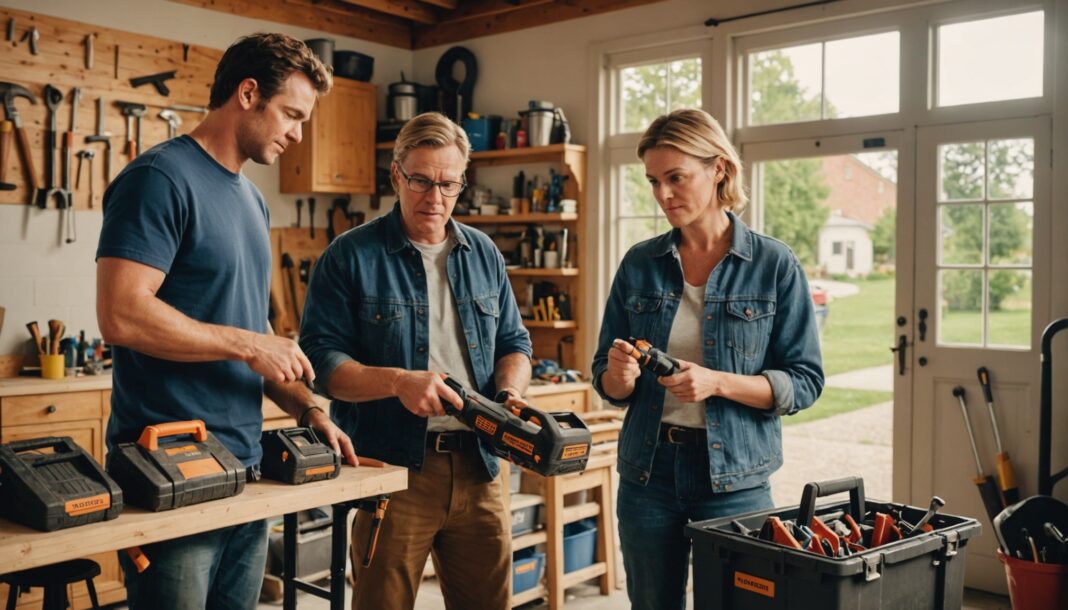
A drill gathering dust at the back of the garage, a sander pulled out once a year, a hedge trimmer used for fifteen minutes a season… As the DIY market remains under pressure, a growing number of French people are turning to peer-to-peer tool rental rather than systematically buying new equipment. It's a deep-seated trend, driven by both economic and environmental reasons.
A DIY Market Still on the Mend
The DIY and gardening sector declined by 2.7% in 2025, for total revenue of 32.5 billion euros in France; the DIY segment alone saw a 3.2% drop, to 24.2 billion euros. A stabilization is nonetheless expected for 2026, after two consecutive years of decline. The reasons: French households' declining purchasing power and the slowdown in the real estate market, which naturally puts the brakes on renovation projects. As a result, 79% of French people say they intend to change their buying habits in DIY and gardening in the months ahead.
This budgetary caution, already visible in the minimalist buying strategies adopted by many consumers, plays out very concretely in DIY aisles: people repair rather than throw away, and borrow rather than buy.
Renting or Sharing Rather Than Buying
It's in this context that solutions for sharing tools between neighbors and short-term peer-to-peer rental are developing. In Brittany, two friends from Saint-Brieuc recently launched a company dedicated to making peer-to-peer tool rental simpler. It's an initiative that illustrates a pattern already noted by regional news outlets: DIY tools, being sturdy and mostly unused the rest of the year, are particularly well suited to sharing between neighbors rather than being systematically repurchased.
In practical terms, this type of solution makes it possible to:
- reduce the cost of a one-off project (painting, tiling, hedge trimming…);
- avoid storing bulky equipment that's rarely used;
- limit the waste and carbon footprint associated with manufacturing new tools;
- gain access to higher-performance equipment, sometimes of professional quality, without bearing the cost of buying it.
Tools Designed to Be Shared Longer
This sharing economy is being facilitated by a deep shift in the tools themselves: the spread of battery systems that are interchangeable across brands. Alliances such as the Cordless Alliance System (CAS), backed notably by Metabo, or AMPShare, supported by Bosch Professional, allow the same battery to be used on tools from different brands. This further simplifies pooling equipment between neighbors or friends, without having to deal with a multitude of incompatible chargers and batteries.
This pursuit of durability is part of a broader movement to extend the lifespan of tools, already encouraged by public programs. The repair bonus (le bonus réparation), which covers DIY and gardening tools among other things, encourages individuals to have their equipment repaired rather than replace it. This choice is all the more relevant since repairability has become a purchasing criterion in its own right for many DIY enthusiasts, who now favor brands that offer spare parts and interchangeable batteries across several generations of devices.
Staying Alert to Equipment Quality
Vigilance is nonetheless still warranted regarding the quality of equipment in circulation, whether bought, rented, or shared: inspections conducted by the DGCCRF (the French consumer protection and antitrust authority) recently revealed worrying non-compliance rates on certain DIY and gardening products. It's a useful reminder for rental platforms and for individuals who share their equipment with neighbors alike: a defective or poorly maintained tool remains a risk, whoever owns it.
Frequently Asked Questions
Is peer-to-peer tool rental really more affordable than buying?
For occasional use—from a few hours to a few days a year—renting is generally much cheaper than buying a new tool, especially for expensive equipment like a concrete mixer, a lift platform, or a professional-grade drill.
Which tools are most commonly shared between neighbors?
Tools used only occasionally are best suited to sharing: drills, sanders, hedge trimmers, ladders, pressure washers, and bulky gardening equipment.
Does the repair bonus apply to DIY tools rented between neighbors?
The repair bonus applies to DIY and gardening tools owned by individuals; it's designed to encourage repair rather than replacement, which naturally complements sharing and rental arrangements between neighbors.
Sources
Profil de l'auteur
Derniers articles
 Retirement & Senior Living24 November 2026Mothers' Retirement: What the New 2026 Pension Calculation Changes
- Home Appliances & Equipment24 November 2026Appliance Repair Bonus: The Little-Known Boost to Fix Rather Than Toss
- Nutrition, Diet & Weight Loss24 November 2026Intermittent Fasting: What the Science Really Shows About Weight Loss
- Restaurants, Drinks & Food24 November 2026Restaurant Trends Set to Reshape How We Eat Out



Trending now on legal streaming
FilmThe Odyssey
SeriesCat's Eyes
This article was written with the help of artificial intelligence. Editorial policy
Table of Contents