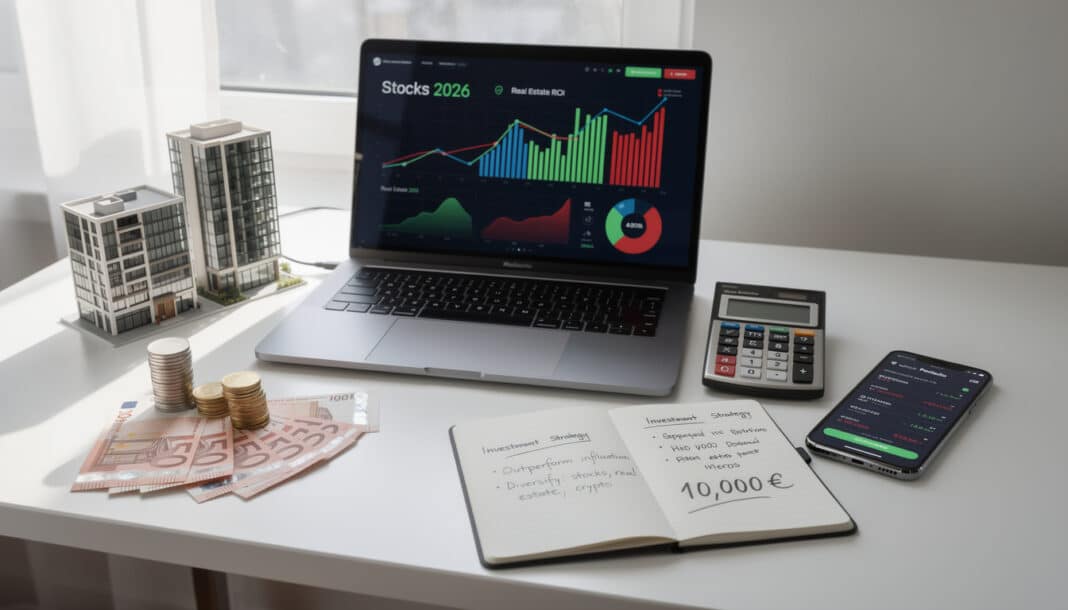
In short — Having €10,000 to invest finally means having the means to diversify your wealth and truly fight inflation. But faced with the jungle of available options — life insurance, the stock market, real estate, savings accounts — the choice becomes a real headache. Between a real estate market that has become technical and less transparent, interest rates that were gradually falling, and the need to beat an inflation rate that stands at 0.8% in France, strategy needs to be well thought out. It’s no longer the era when owning property was enough; you now need to combine several building blocks, adjust your risk profile, and accept that the “right” answer is less obvious than before.
💰 When €10,000 Becomes a Real Key to Your Wealth
In recent years, the act of saving has become more complicated. In the past, the path was clear: open a savings account, buy property. Today, it’s much more nuanced. Ten thousand euros mark the turning point where emergency savings become a real investment project. It’s enough to diversify, not enough to ignore fees, not enough to afford a very costly mistake.
Beating inflation then becomes a concrete, almost vital necessity. With returns of 1.7% on the livret A and the LDDS, then 1.5% from February, the gap against an inflation rate of 0.8% seems small. Yet, over several years, that difference accumulates. That’s why multiplying sources of return — combining security and controlled risk-taking — becomes the smart approach.

🏦 Savings accounts: the reassuring but limited foundation
Let’s start with the obvious: part of the €10,000 must remain liquid, immediately accessible. That’s what we call emergency savings, and it’s not intended to make you rich; it exists to help you survive. Three to six months of expenses for a salaried worker, six to nine months for a self-employed person — that’s the order of magnitude.
The livret A or the LDDS offer this absolute security: guaranteed capital, no fees, advantageous taxation. But their ceilings (€22,950 for the livret A, €12,000 for the LDDS) often force you to look elsewhere for larger amounts. Super bank savings accounts, with boosted rates up to 4% for three months, then stabilizing around 2%, represent an attractive alternative — at least temporarily.
However, this choice only solves part of the puzzle. With a net return of 1.5% to 2%, you only barely beat inflation. That’s why not all of the €10,000 should go there. The classic trap? Parking all your money in a “safe” investment and watching, over the years, your purchasing power erode silently.
🛡️ Life insurance: the envelope with a thousand faces
Life insurance remains the French favorite investment, and for good reason. Contrary to what its name suggests, it is not primarily an insurance product — it’s an investment wrapper with notable tax advantages and an almost unlimited range of assets.
It operates across two distinct universes: the euro funds, secure but low-yielding (generally 2% to 3% depending on the contract), and the unit-linked investments, which give you access to stocks, SCPI, ETFs, and even commodities. The beauty of the system lies in this flexibility: you choose the security-return ratio according to your investment horizon.
After eight years of holding, gains benefit from reduced taxation (24.7% instead of 30%) and an attractive annual allowance (€4,600 for a single person). That significantly changes the picture compared with a simple brokerage account. For a best investment 2026 where taxation matters, life insurance deserves its reputation.
It remains important to choose the right contract. Not all euro funds are equal: rates vary, fees too. And if you want access to specific unit-linked investments (real estate via SCPI, niche stocks, etc.), some contracts exclude what others generously offer.
📈 The stock market via the PEA: longevity and fiscal agility
For those who want exposure to equity markets without excessive tax constraints, the PEA remains incomparable. After five years of holding, gains become almost exempt (only social contributions at 18.6% remain), versus 31.4% on a standard brokerage account. That’s a considerable gap over the long term.
With €10,000, you pass the threshold where geographic diversification makes sense. Limiting exposure to Europe would be short-sighted: ETFs tracking the MSCI World or the S&P 500 offer global exposure while remaining eligible for the PEA. History shows that the MSCI World has posted an average annual return of nearly 10% over fifty years — the kind of performance you aim for to beat inflation over time.
However, respect a golden rule: don’t invest €10,000 in one go during a period of market uncertainty. Staggered contributions monthly or quarterly (for example, €1,000 each month for ten months) smooth out risk and spare you the nightmares of “bad timing.” Between staged deposits, keep the surplus in a savings account for peace of mind.
See our recommendations to better understand which investments to favor in 2026 according to your profile.
🏠 Indirect real estate: when brick becomes paper
SCPI — Sociétés Civiles de Placement Immobilier — offer an entryway into the real estate market without the complications of direct ownership. With €10,000, you gain access to a diversified portfolio of offices, retail, housing, warehouses, potentially spread across France or beyond.
The average yield hovered around 4.7% in 2024, but variability is significant. High-performing corporate SCPIs can show 6%, even 11% for the best. Residential SCPIs, usually less remunerative, compensate with tax advantages (Malraux, Denormandie) that reshape your personal taxation.
However, don’t forget that this capital is not guaranteed. The real estate market we experienced in 2025 — with price drops exceeding 10% in certain sectors — shows that brick is never as solid as you might think. SCPIs suffered; some reduced their distributions. Investing in SCPIs means accepting this volatility, even if it unfolds over time.
Read our analysis to see how different investments compare in 2026.
🌍 Diversification with gold and crypto: the safe-haven assets
Once the foundation is built (savings accounts, life insurance, stocks, real estate), the €10,000 can include a dose of exotic diversification: gold or cryptocurrencies. Warning: this should not exceed 5% to 10% of your overall wealth, depending on your risk tolerance.
Gold hit record highs in 2024 and 2025, driven by geopolitical tensions in the Middle East and by growing demand from central banks in emerging countries seeking to reduce dollar exposure. This dynamic could continue, even if gold remains a safe investment mainly as insurance against systemic shocks, not as a primary wealth generator.
Cryptocurrencies oscillate between two extremes. Theoretically uncorrelated with traditional markets, they actually behave like volatile tech stocks — and since the SEC approved Bitcoin and Ethereum ETFs, that correlation has only increased. Investing €1,000 in Bitcoin or Ethereum via an ETF can be enough to give you exposure without risking your overall capital.
🎯 Orchestrating your €10,000 investment: the profile puzzle
Here lies the real challenge. How do you assemble these building blocks to get the most while remaining coherent with your situation? A conservative investor with a stable life could consider: €3,000 in a savings account (emergency fund), €4,000 in a life insurance policy invested in euro funds, €3,000 in a PEA staggered over a year. No risk of loss, a simple investment strategy, moderate taxation.
A balanced investor seeking yield: €2,000 in a savings account, €3,000 in a life insurance policy (50% euro funds, 50% diversified ETFs), €3,000 in a PEA staggered, €2,000 in income-generating SCPI. Here, you accept moderate volatility to target 4% to 5% average annual returns.
An aggressive investor with little fear: €1,500 in a savings account (minimum safety), €2,000 in a life insurance policy (100% aggressive unit-linked investments), €4,000 in a diversified PEA, €1,500 in more aggressive SCPI, €1,000 in gold/crypto for the thrill.
The secret? Know your horizon. Do you need this money in two years? Ten years? Liquidity needs must take priority: don’t lock up your savings in an illiquid asset if you know you’ll need it.
💡 Beating inflation: rely on compounding, not magic
The real victory against inflation doesn’t come from a miraculous investment claiming 20% annually. It comes from consistency: saving regularly, investing intelligently, letting interest do its work over years.
With €10,000 invested at an average net return of 3.5% per year (a realistic, balanced target), you generate €350 of gains the first year. In ten years, if you don’t touch anything and the rate stays stable, you’ll have about €13,800 in total gains. The inflation that would have eaten away €8,000 by then would have been largely offset. It’s less spectacular than a big stock market windfall, but it’s solid.
Discover how to invest intelligently this year to truly beat inflation.
🔍 Traps to absolutely avoid
Too often, savers fall into the same pitfalls. The first? Chasing returns without understanding risk. An equity ETF may show 10% annual averages, yes, but it can drop 30% in six months. Are you ready to endure that psychologically?
The second trap: ignoring taxation. Investing €10,000 in a standard brokerage account where you’ll be taxed at 31.4% effectively hands nearly a third of your gains to the state. Taking the life insurance or PEA route changes the picture considerably.
The third: being seduced by trends. In 2025–2026, SCPIs suffered, real estate proved less easy than before, crypto still makes roller-coaster moves. Placing €10,000 in whatever headlines are screaming is rarely a good long-term idea.
Finally, the fourth: failing to diversify. All in on real estate, all in on stocks, all in on a single savings account — that concentrates risk unnecessarily. Your €10,000 deserves at least three or four different supports.
📊 Rebalancing your portfolio: a habit, not an exception
Once your allocation is in place, don’t let it sleep. Each year, check that your distribution hasn’t drifted. If you planned 50% stocks and 50% bonds in your life insurance policy, and stocks have risen 15% while bonds stagnated, your allocation is now unbalanced — 55% stocks, 45% bonds. Return to your target.
This rebalancing work, tedious as it may seem, protects your wealth. It also forces you to sell “hot” assets (that have performed well) to buy depressed ones — it’s the discipline every successful investor must cultivate.
Also review your objectives every two or three years. An investment horizon that was thought to be ten years turns out to be five? Adjust your risk exposure accordingly.
🎓 The role of fees and hidden costs
One detail too many savers neglect: fees. A life insurance policy with annual management fees of 1.5% on unit-linked investments costs you €15 each year on €1,000 invested. Multiplied over ten years and on €10,000, that means €1,500 gone up in smoke before performance even plays a role.
By comparison, an ETF tracking the S&P 500 often costs 0.05% annually — a hundred times less. That gap becomes colossal over the long term. That’s why choosing the right vehicles — low-cost ETFs, life insurance with solid euro funds — really matters.
Also beware of eye-catching welcome bonuses. A super savings account offering 4% for three months? Splendid, but that rate will drop to 2% afterwards. If you only planned a three-month placement, excellent. Otherwise, weigh your calculation over the real duration.
🌱 Cultivate patience: your best ally
Investing €10,000 is not a sprint; it’s a marathon. The temptation to check your portfolio every day, to panic at the first 3% drop, to juggle between investments is strong. That agitation almost systematically harms returns.
The best investors are often those who forget they invested — who leave things alone, who don’t succumb to the sirens of speculation. Ten years without touching is a strategy. Ten years of constant fiddling is the recipe for disappointment.
See our best investments for 2026 and select those that truly match your investor philosophy. Once you’ve chosen, stick with it.
🚀 The return curve: patience and long-term vision
To illustrate, imagine Martin, a 35-year-old employee who decides to invest his €10,000 according to the balanced scheme described above. In the first year, the combined net return is about 3.2% — €320. It’s not exciting, but it adds to the initial capital. In the second year, he adds €3,000 of new savings, invested according to the same allocation. Now the return rises to nearly €400.
By the tenth year, with compounding and continued contributions, the capital has doubled or tripled, depending on market conditions. By the twentieth year, we’re talking about multiplying by five or six. It’s not thanks to a miraculous investment; it’s steady-state accumulation applied like a proven recipe.
Here’s the secret advertisers don’t like to reveal: there is no shortcut to wealth, just time, discipline, and acceptance that €10,000 today becomes €15,000 in ten years if well invested.
Browse our detailed guide to discover how to invest €10,000 to become gradually financially independent.
💎 Tailor your investment to your personal situation
No investment is universal. A self-employed person with volatile income cannot place their €10,000 the same way as a civil servant with a stable salary. The first needs more liquidity, a larger emergency fund. The second can afford a more assertive risk-taking approach.
A young couple planning to buy property in three years must protect their down payment, so minimize volatility. A couple in their fifties without urgent projects can accept substantial equity exposure. The same capital — €10,000 — will therefore have radically different destinations depending on context.
That’s also why talking about “the best investment” is a bit naive: there is only the best investment for you, at this moment in your life, with your money, your dreams and your fears.
🔐 Insurance and inheritance: think beyond yourself
A lesser-known advantage of life insurance: transmission. If you die, your beneficiaries inherit your payments made before age 70 with very favorable taxation (exemption up to €152,500 per beneficiary, then 20%). Compare this with a brokerage account where inheritance tax applies in full.
This element, seemingly trivial, changes the picture for anyone planning their family’s future. Your €10,000 thus becomes a brick in a broader wealth architecture.
📈 Profitability vs. peace of mind: the real debate
Seeking 5% annual return is tempting. But achieving it forces you to accept a volatility you may dread. That’s the heart of the dilemma: return and peace of mind don’t always go hand in hand. A 3% investment that lets you sleep at night is often better than a 6% investment that constantly stresses you out.
Ask yourself honestly: if your €10,000 dropped 20% in six months, could you tolerate it without selling in panic? If the answer is no, reduce your risky allocation. If yes, you may have too few equities. The balance is personal, rarely universal.
Explore our resources to learn about the 5 best investments to grow your €10,000 savings.
🌟 Investing €10,000: from reflex to structured project
Many see their €10,000 as a sum “to invest” — a mechanical, almost obligatory act. That’s a mistake. This €10,000 represents a choice, a philosophy, a vision of your own future. Placing it without thinking about your horizon, your profile, your dreams, is leaving to chance what should be a deliberate decision.
The best investment in 2026 is the one that matches who you really are — your fears, your ambitions, your constraints. It’s the one you will hold for ten years without panicking at every market turbulence. It’s the one that, quietly, will widen the gap between inflation and your capital, month after month, year after year, until it turns that €10,000 into something more substantial.
Whether that path is calming savings accounts, reassuring life insurance, structured stock investments, paper real estate, or a clever combination of all these elements — the only imperative is to act now, with discernment, without being paralyzed by the unattainable quest for perfection.
Also check our investment strategies for potentially profitable investments in 2026 and refine your vision.
Ten thousand euros is at once little and a lot — little to instantly transform your life, a lot to create a lasting dynamic if you use it wisely. The rest is time. Give it time, and it will give it back to you.
Profil de l'auteur
Derniers articles
 Smartphones & Mobile Phones14 October 2026The loyalty penalty on your mobile bill: why staying put costs you more
- Family, Babies & Children5 October 2026Airline family seating fees: what the planned ban will change for parents
- Everyday Life & Society23 September 2026Consumer confidence index: what the monthly mood check on British households really measures
- Agency, Webmarketing & SEO31 August 2026SEO : a Google bug skews visibility statistics in AI results




Table of Contents