


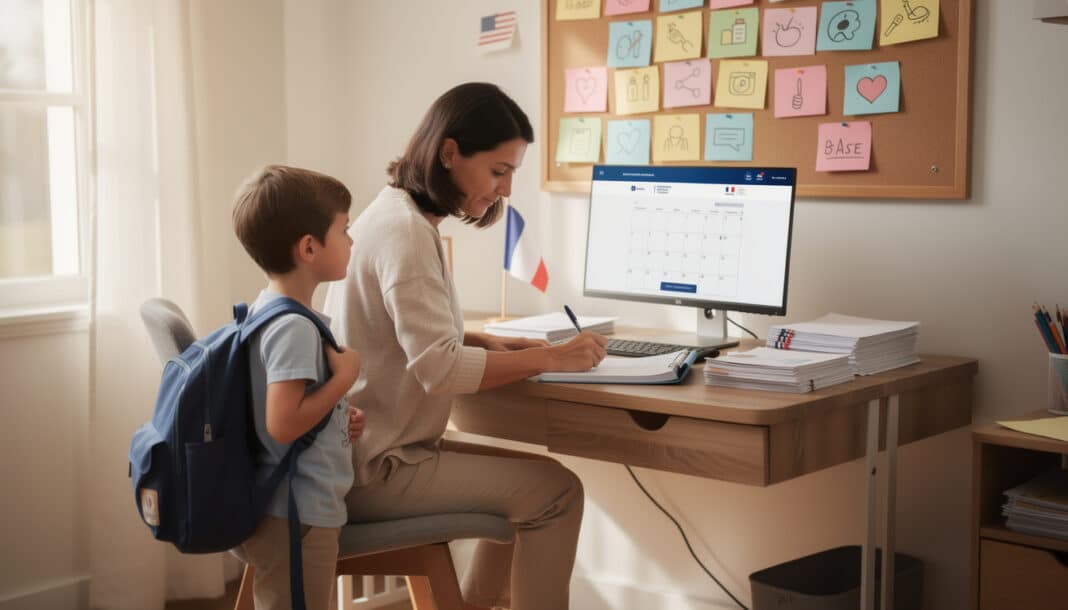
In short : Registration for CP marks a turning point in the child's and family's life. From April, families must begin the procedures with their town hall to secure their child's place for the start of the school year. The school assignment certificate, obtained after the submission of supporting documents, conditions access to the school. June represents the deadline to finalize primary school registration. Accommodations exist for children born late in the year or those seeking an exemption to the school catchment area. Éducation nationale requires a specific list of registration documents to be provided, including the family record book and the health record. For families seeking alternatives, private school opens its doors from September to January.
The CP registration timeline: don’t miss the key steps
Registering your child for CP is like binding a book with care: every action, every step must follow a precise order so the whole holds together firmly. The registration date is never really trivial – it shapes the coming year, it organizes the days to count. Starting in April is like preparing the ground before the rain makes it impassable.
The town hall or the school registration office then becomes the first port of call. It is there that everything begins, in offices that smell of administrative paper and filed records. You must make an appointment with the person in charge of the intended school, armed with various supporting documents. June embodies the finish line: it is the last month to complete this CP registration before summer suspends the procedures and time seems to stretch.

Essential documents for primary school registration
Every parent facing CP child registration quickly discovers that the administration requires a ballet of papers: each one tells part of the child's story. The family record book or the birth certificate first establishes identity. The legal guardian's identity card confirms that the person acting has the right to do so. A proof of address – bill, lease, or bank statement less than three months old – proves the family's territorial anchoring.
The health record deserves particular attention: it attests that the child has received the mandatory vaccinations. This document, often annotated by trembling hands at the time of the first vaccinations, becomes an indispensable passport. If the child has their own identity card, it is worth slipping it into the file. Some schools also request a recent ID photo, as if to fix a moment of the child's still-unchanged face.
Once these documents are assembled, the town hall issues a school assignment certificate that directs the child to the school in their sector. This document, simple but decisive, opens the door to the true registration: the one that will be carried out directly with the establishment, with the principal who will welcome each child as a new link in the educational chain.
Understanding zoning and requesting an exemption
The school catchment map resembles an invisible but tenacious thread: it links each address to a specific school, based on the neighborhood, postal code, arrondissement. This zoning theoretically guarantees a certain equality, a certain proximity. Yet reality does not always coincide with administrative geography.
Legitimate reasons allow you to request an exemption: gathering several children in the same school (siblings, that family wealth), getting closer to a parent's workplace, organizing after-school care without stressful juggling, benefiting from specialized support that another school offers better. The exemption form must be filled out quickly, without delay after receiving the school assignment certificate. A sincere and detailed letter of motivation can tip the balance.
It must be said plainly: places remain limited, and the exemption is never guaranteed. It is therefore better to provisionally register the child at the designated local school, in case the exemption is denied. It is a form of prudence, administrative wisdom that one learns with the years of parenting.
Private school: a distinct timeline and details to know
Choosing private school responds to varied motivations, philosophical or practical. The timeline differs: private school registrations run from September to January for most institutions. You must contact the head of the establishment directly, without going through the town hall, without waiting for a sector certificate.
The administrative procedures resemble those of the public system – family record book, birth certificate, legal guardian's identity card, proof of address, health record. But some private institutions add a personal touch: a letter of motivation from the parents, explaining the reasons for the choice, adherence to the school's values, and expectations for the child's education.
The pitfall to know: waiting lists. Faced with a popular and saturated private school, you must keep the public school registration in parallel. A child cannot be left without a school, and this dual approach provides security, a safety net in case of disappointment. To navigate these choices effectively, practical tools such as the one dedicated to funding for continuing education can shed light on some aspects of choosing a school.
Special cases: children born late in the year and changes of residence
A child born in November or December is in a gray area: they will be almost 6 years old at the September start, but not quite. The rule states that a child enters CP in the school year in which they turn 6. So a child born in December 2020 will start CP in September 2026, when they will be only 5 years and a few months old.
Some schools, subject to available places, accept a delayed start during the school year for children born in early February, taking into account their developmental pace. This is never an obligation: checking with the town hall remains the prudent step to explore this flexibility. The question deserves to be asked without guilt: every child progresses at their own pace.
Moving during the school year often triggers a change of school. The choice remains: either let the child finish the year where they are, thus preserving valuable stability, or register them immediately in the new school if places are available. Before acting, contact with the new establishment is appropriate. A certificate of deregistration from the previous school will prove that the child is no longer attached to that establishment. It is an administrative formality, certainly, but it carries meaning: every child must remain tracked, followed, welcomed.
Very young children and Toute Petite Section classes
Since 2019, Éducation nationale has made schooling compulsory from age 3. But what about the even younger ones, those who are only 2 years old? Toute Petite Section (TPS) classes exist, tucked into a few nursery schools only, with places that are infinitely rare and precious.
These classes require a specific level of readiness: children must be toilet-trained or at least on the way to autonomy. The spaces are designed for the very young, secured, equipped with furniture adapted to their small size. Teachers receive special training, aware that at this age everything is body language, sensory attachment, learning through exploration.
This solution is never imposed: no legal obligation weighs on parents. It responds rather to a necessity or a desire, a confidence that at this age the child will benefit from being around other children and a structured environment. Staying at home remains a legitimate and valid choice. Early childhood hides mysteries that school alone cannot solve.
Using digital services to simplify procedures
Digital technology now invites itself into the school's administrative world. Online services allow you to centralize several procedures: update the child's information form, obtain a school certificate, fill out certain parental authorizations without having to travel every time. This dematerialization offers a significant time saving, particularly for families where both parents work and every moment counts.
These digital tools remain, however, complements, never replacements for the initial registration with the town hall. The initial access, the one that underpins everything else, still requires a physical presence, documents in hand, direct exchange with the person in charge. Perhaps this is fortunate: in an era where so much is virtualized, a child's registration retains a part of its materiality, of its real anchoring.
To deepen knowledge of funding schemes or legal implications related to registration, particularly if questions of loans or school-related investment arise, resources such as those devoted to real estate financing solutions can also prove useful if families are considering moving because of school choice.
Anticipate and organize for a calm registration
CP registration is never a last-minute emergency. Starting in April gives breathing room to the organization, preserves you from the anxiety of tight deadlines. Gathering documents little by little, checking that the health record is up to date, that the photocopy of the family record book is readable: all these tiny, repeated gestures build solidity.
Keep a physical or digital file, note deadlines on a visible calendar, remember the names and contact details of the person to contact: these are the discreet but effective rituals of organized parenting. It is less about perfection than about kindness to oneself, a form of care given to this major transition.
This passage from the world of nursery (or home) to the universe of CP carries a strong symbolic charge. The child grows, becomes a schoolchild, is enrolled in a larger community. For parents, it is the moment to let go, gradually but surely. That the administrative procedures be carried out with clarity, without stress, helps make this start of the school year a moment of calm rather than panic – a beginning that honors what this child brings to the world.
Profil de l'auteur
Derniers articles
 Electricity, Gas & Energy14 September 2026Gaz et électricité : ce que la hausse des tarifs va changer sur votre facture
- Agency, Webmarketing & SEO12 September 2026Fusion Omnicom-IPG : ce que la plus grande agence de publicité au monde change pour les marques
- Retirement & Senior Living10 September 2026Carte Avantage Senior SNCF : comment voyager moins cher en train après 60 ans
- Tech & Multimedia8 September 2026Objets connectés : la fin de la 2G et le nouveau Data Act vont rebattre les cartes




Table of Contents

: discover the essential administrative procedures and key dates for a successful start to the school year.)