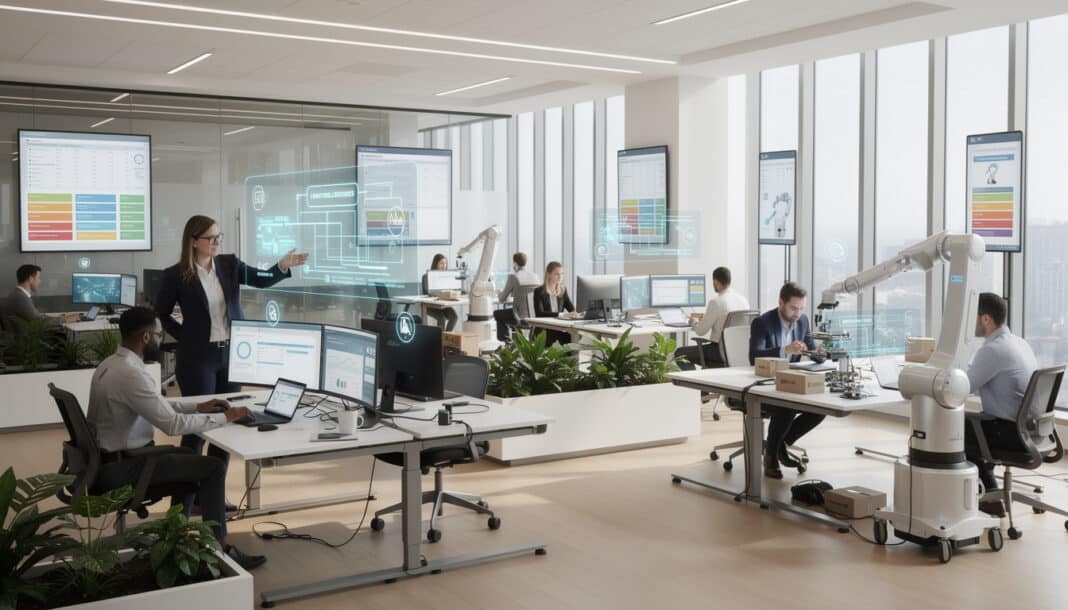
📊 In brief — Artificial intelligence is profoundly transforming the organization of work, far beyond simple automation. Far from massively replacing jobs, it redraws tasks, skills and hierarchies. Organizations must rethink their structures to accommodate this digital transformation, while employees face new adaptation challenges. Between promises of increased productivity and legitimate fears, the real issue lies in the ability to build a genuine complementarity between humans and machines.
🔄 Task automation, not job automation: a crucial distinction
For several years a myth has persisted: that of an artificial intelligence that destroys jobs. However, studies conducted by French and European research institutions considerably nuance this apocalyptic picture. The transformation underway looks less like a disappearance than a mutation.
When you scrutinize the data, you discover that AI replaces repetitive, codified tasks — data entry, sorting, prioritization — rather than jobs in their entirety. It's as if, in the bookbinding workshop, one entrusted a machine with the regular gluing of the book's spine, while keeping the delicate hand gestures for folding. The task changes, but the work endures, enriched with a new dimension.
This distinction is fundamental. The impacts of artificial intelligence on work and employment reveal that organizations that adopt these technologies experience more of a redistribution of responsibilities than a net elimination of jobs.
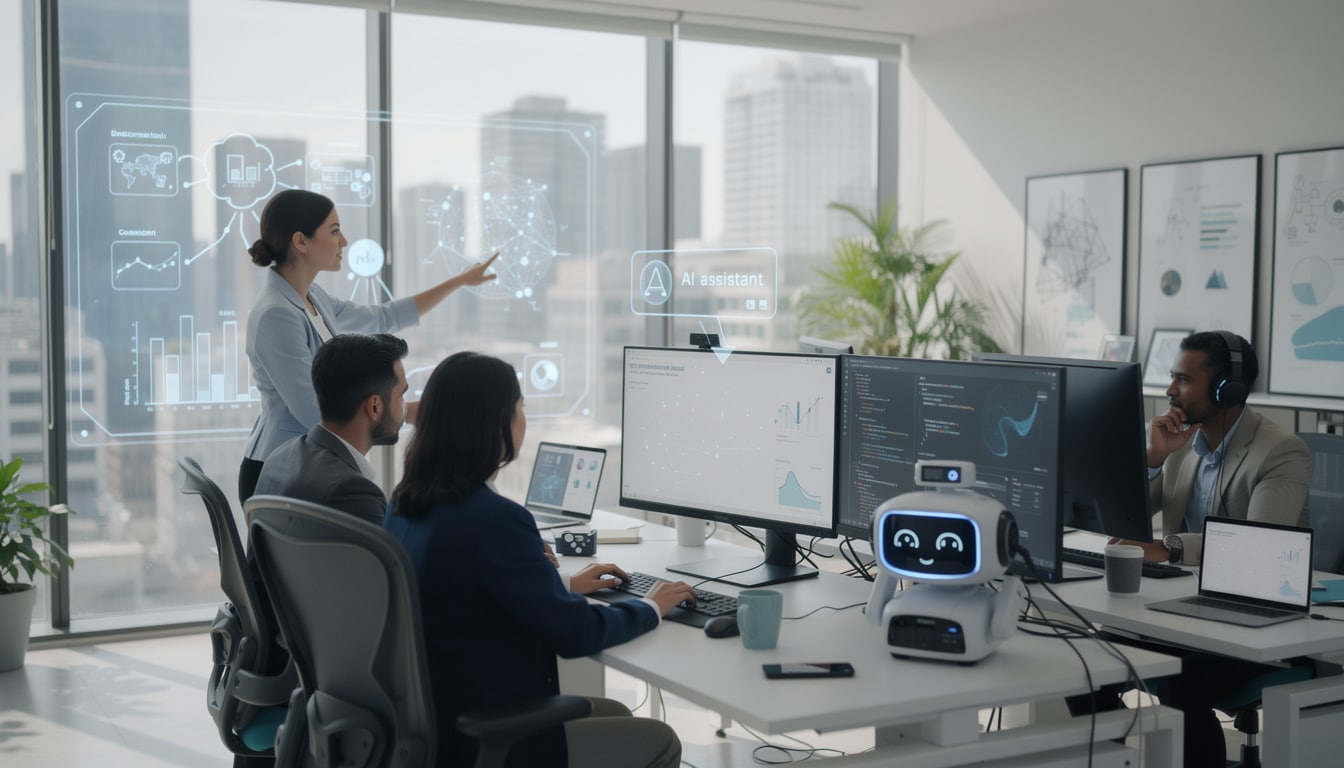
💡 When algorithms free up time for creativity
Think of a project manager before AI: they spent hours collecting, analyzing and reporting scattered information. Today, intelligent tools produce a synthesis in seconds, freeing up time for strategic thinking and human coordination.
Planning, analysis and the detection of crucial information — once time-consuming — become the domain where the alliance between humans and machines bears fruit. AI captures patterns; humans derive meaning from them.
🏗️ New organizational structures: towards a model in transformation
With technological innovation comes an inevitable question: how to restructure the internal organization? Pyramid hierarchies, designed for control and centralization, no longer correspond to the needs of a company equipped with decentralized and autonomous tools.
Several models are emerging. Some organizations opt for smaller, cross-functional teams, where everyone collaborates directly with AI systems. Others retain a more classic hierarchy but introduce new roles: human AI coordinators, data ethicists, specialists in technological adaptation.
What is striking is the diversity of responses. There is no single right structure. It all depends on the nature of the sector, the internal culture and the vision held by leaders.
⚙️ Human resources management reinvented
Human resources management does not survive this revolution unchanged. Recruitment itself is affected. The deployment of AI in organizations and its use in recruitment raises ethical issues but also a real opportunity: identifying talent not by CV but by potential and complementarity with available tools.
Training becomes central. Faced with this shift, companies must invest heavily in the acquisition of new skills — not only technical but also interpersonal. How to manage a mixed team? How to cultivate empathy and communication when half of the interactions occur with automated systems?
These questions were not on the agenda ten years ago.
📈 Productivity at the heart of the debate: real gains, social stakes
Promises around the improvement of productivity are not in vain. Better information management, smoother planning, optimized coordination — AI tools deliver measurable results.
Yet this increase comes with a tension: who really benefits from these gains? If productivity rises but wages stagnate, if work paces accelerate without well-being improving, we risk a new form of alienation, more subtle than the old ones.
🎯 Concrete cases: small and large organizations facing the transformation
In an SME specialized in logistics, the introduction of routing algorithms reduced order processing time by 30%. But it also required employees to train on new interfaces and to reinvent themselves in roles more oriented toward customers.
For a large public administration, AI has facilitated the verification of files, reducing administrative errors. At the same time, staff were able to focus on complex situations requiring genuine human judgment — exactly what no one can do as well as we can.
These examples outline a trend: productivity gains are always accompanied by a phase of organizational discomfort. This transition demands collective intelligence, not just artificial.
🤝 Skills adaptation: a central challenge of the decade
If artificial intelligence does not destroy employment, it requires a rapid adaptation of skills. Professionals interviewed by French researchers emphasize an urgent need: to train teams not only to use the tools, but to accompany them, critique them, redirect them when they go astray.
It is a new form of literacy. No need to become an AI engineer, but rather to cultivate a real digital literacy — understanding what the tool can and cannot do, recognizing its potential biases, knowing where to intervene as a person.
🎓 Continuous training: an unavoidable investment
Sustainable organizations are those that treat training not as a cost but as a survival strategy. That means continuous programs, not one-off training sessions, and a recognition that every employee, whatever their hierarchical level, must be able to evolve.
Learning also becomes more horizontal. A young hire, digital native, can teach a senior executive how modern interfaces work. Experience barriers are cracking.
⚖️ Emerging tensions: productivity versus workplace well-being
One question remains hanging, almost muted but pressing: at what human cost does this digital transformation occur? If repetitive tasks disappear, new ones replace them. And sometimes, these are merely disguised forms of more refined control.
Algorithmic surveillance of employees — via productivity tracking tools, behavioral monitoring — remains a gray area. Technically possible, legally regulated but insufficiently, ethically questionable.
🔒 The fragile balance between optimization and humanity
In some organizations, AI becomes a substitute for management. Decisions about promotions, schedules or the allocation of tasks are made according to statistical models. The fear is legitimate: we lose the ability to take singular contexts, personal difficulties, and what makes a human being irreducible into account.
It is precisely here that nuance becomes political. The impact of AI on the organization of work does not depend on it alone, but on the choices of the humans who implement it. Same system, different visions, diametrically opposed results.
🌱 Toward a considered, not endured, complementarity
The most inspiring companies of 2026 are not those that maximize automation, but those that think deeply about the authentic complementarity between humans and AI.
Imagine a graphic designer working with an AI assistant that proposes variations, analyzes trends, suggests improvements. No subjugation: an amplification of their creative capacities. Or a caregiver supported by a tool that centralizes patient data, freeing up time for contact, for listening.
This vision entails a willingness to innovate that places human work at the center, not on the periphery. It also implies that organizations accept a form of thoughtful slowness — taking the time to properly integrate technologies, rather than deploying them hastily.
📚 Learning from past models
Strangely, artisans have always known this. Bookbinding, for example, was transformed by machines. But bookbinders did not disappear. They changed roles. Less on the mechanical task, more on design, material choice, the uniqueness of the object.
Perhaps 21st-century organizations could be inspired by the workshops of old: a gradual integration of tools, a preservation of expertise, and a conviction that technology is a means, never an end.
🚀 The challenges of tomorrow: toward resilient structures
In 2026, the real debate is no longer whether AI transforms work, but how we govern it so that it serves fulfillment rather than subjugation. This engages the responsibility of leaders, researchers, and policymakers.
The organizations that will survive and prosper will be those that have built adaptable and humane structures — capable of welcoming innovation without renouncing values. They will have invested in training, anticipated transitions, and dialogued with their teams.
And they will have understood an essential lesson: artificial intelligence is only a tool. It is human intelligence that decides what we do with it.
What world of work do we want to build together?
Profil de l'auteur
Derniers articles
 Electricity, Gas & Energy14 September 2026Gaz et électricité : ce que la hausse des tarifs va changer sur votre facture
- Agency, Webmarketing & SEO12 September 2026Fusion Omnicom-IPG : ce que la plus grande agence de publicité au monde change pour les marques
- Retirement & Senior Living10 September 2026Carte Avantage Senior SNCF : comment voyager moins cher en train après 60 ans
- Tech & Multimedia8 September 2026Objets connectés : la fin de la 2G et le nouveau Data Act vont rebattre les cartes




Table of Contents